
Kitchen design is increasingly about more than choosing cabinets, worktops and appliances. Storage, movement and everyday routines are also shaping how people plan their kitchens.
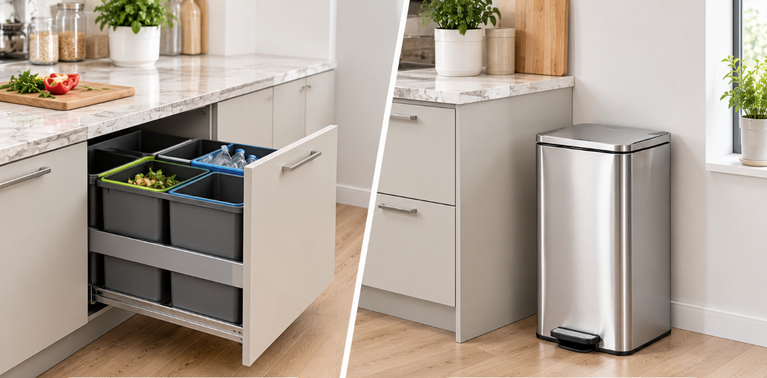
The 2026 UK Houzz Kitchen Trends Study highlights the continued importance of built-in storage and task-specific kitchen areas. It reports that 55% of homeowners renovating their kitchens included pull-out waste or recycling bins in their upgraded cabinetry.
This is an interesting signal for the household products industry. Waste management is not only something that happens after a product is used. It is also becoming part of how kitchens are organised and designed.
For retailers and importers, this raises a practical question: how should freestanding waste bins fit into kitchens where space, storage and appearance are planned more carefully?
1. The Kitchen Is Being Planned Around Everyday Tasks
A modern kitchen often needs to support several activities at the same time: food preparation, cooking, cleaning, storage and sometimes working or socialising.
The Houzz 2026 UK Emerging Trends Report also points to interest in more specialised kitchen layouts, including dedicated drink stations and improved storage solutions.
The wider message is not that every home is adopting the same kitchen design. It is that homeowners and designers are paying attention to how different areas function.
Waste disposal is part of this routine. A bin that is difficult to reach, awkward to open or poorly positioned can interrupt everyday kitchen tasks.
2. What Does This Mean for Waste Bin Design?
A waste bin does not need to be built into a cabinet to fit a well-planned kitchen. Freestanding models still have a role, particularly where users want flexible placement or do not want to modify existing cabinetry.
Several practical details deserve attention.
Position and footprint
A bin should fit the available space without obstructing cabinet doors, drawers or walkways.
Square or rectangular models may be convenient in some layouts because they can be positioned close to a wall or cabinet. However, the actual footprint and lid-opening clearance should always be checked.
Opening method
Pedal-operated lids allow users to open a bin without using their hands. This can be useful during food preparation, although the pedal position and lid movement should be considered when selecting a location.
Capacity
A larger bin may reduce how often it needs to be emptied, but it also occupies more floor space. The appropriate capacity depends on household size, waste volume and collection frequency.
Appearance
As kitchens become more visually coordinated, the finish and shape of a freestanding bin can affect how well it fits into the room.
Brushed stainless steel, for example, can work with a range of kitchen finishes, while coloured surfaces may suit more specific interior schemes.
3. Built-In and Freestanding Bins Serve Different Needs
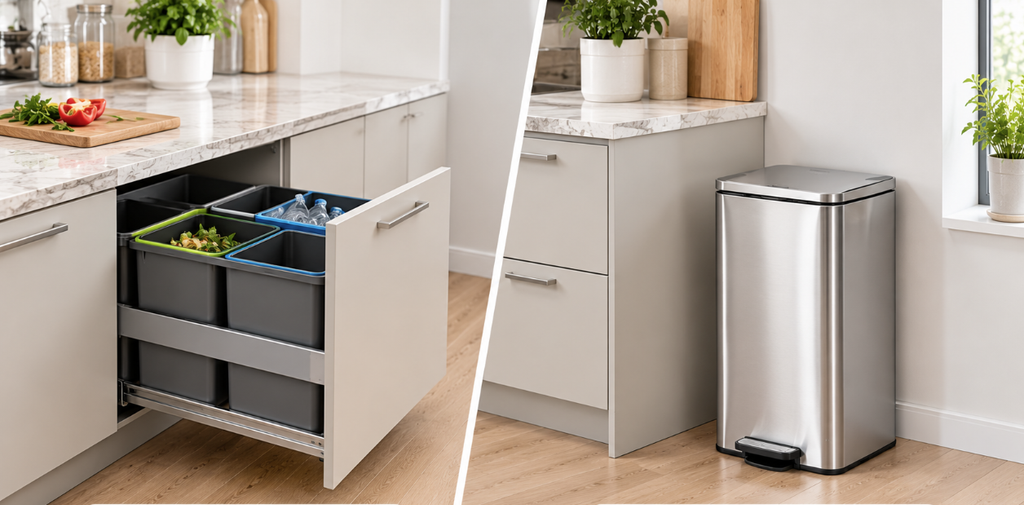
The growing interest in integrated waste storage does not make freestanding bins irrelevant. They solve different problems.
| Consideration | Built-in waste storage | Freestanding waste bin |
|---|---|---|
| Installation | Usually requires suitable cabinet space and fittings | Can generally be positioned without cabinet modification |
| Flexibility | Position is linked to cabinet layout | Can be moved when needed |
| Capacity | Limited by available cabinet dimensions | Available in a wider range of standalone sizes |
| Maintenance | Access depends on the cabinet system | Usually easier to remove from its position for cleaning |
| Suitable users | Homeowners planning or renovating a kitchen | Existing homes, renters and users who prefer flexible placement |
The right choice depends on the kitchen layout and the user’s priorities. In some homes, both approaches may be used: an integrated system for recycling and a separate freestanding bin for general waste.
4. Why Retailers Should Pay Attention to Size and Product Range
The design trend creates an opportunity to review how kitchen waste bins are presented.
Instead of treating every model as a separate product, retailers may organise products around practical applications:
- Compact bins for smaller kitchens or limited floor space.
- Medium-capacity bins for everyday household use.
- Larger models for families or higher-volume waste.
- Recycling models for households that separate different materials.
- Matching designs that allow customers to coordinate products across rooms.
Clear product information is essential. Capacity alone does not tell customers whether a bin will fit beside a cabinet or under a counter. Product dimensions, lid clearance and application photographs can help customers make a more informed decision.
5. A Note for Importers: Do Not Follow a Design Trend Without Checking the Use Case
A popular kitchen design idea does not automatically translate into demand for a particular waste bin.
Before expanding a product range, importers should consider:
- Whether their target customers prefer built-in or freestanding waste solutions.
- The typical kitchen sizes and layouts in their market.
- Whether customers prioritise capacity, appearance or ease of cleaning.
- Which product dimensions are suitable for common placement locations.
- Whether the product range offers meaningful differences rather than unnecessary size variations.
Retailers can also review customer questions and product returns to identify whether buyers are having difficulty with dimensions, lid clearance or placement.
6. The Product Opportunity: Practical Design That Fits the Kitchen
For manufacturers and suppliers, the opportunity is not simply to make a bin look more decorative.
A useful kitchen waste bin needs to balance:
- A practical footprint.
- Convenient opening and closing.
- Suitable capacity.
- A surface that is manageable in everyday use.
- Packaging that protects the product during delivery.
- Clear dimensions and product information for online and offline sales.
For example, a square pedal bin series can give retailers several capacity options within a consistent design. Buyers can evaluate smaller models for compact spaces and larger models for kitchens with higher waste volumes.
The important point is to match the product to the actual space and usage rather than assuming that one design works for every kitchen.
Frequently Asked Questions
Are built-in kitchen bins replacing freestanding bins?
Not necessarily. Built-in systems are useful for planned cabinetry, while freestanding bins offer flexibility and can be added without modifying existing furniture.
What should buyers consider when selecting a kitchen waste bin?
Capacity, footprint, lid clearance, opening method, cleaning requirements and appearance should all be considered.
Why is product photography important for online waste bin sales?
Customers need to understand the product’s size and how it may fit into a real kitchen. Clear dimensions and realistic application images can reduce uncertainty before purchase.
Final Thoughts
Kitchen design is placing greater attention on storage, organisation and everyday routines. Waste bins are a small part of the overall kitchen, but they still influence how conveniently the space works.
For retailers and importers, the opportunity is to offer products that combine practical use with a suitable appearance and clearly communicated dimensions.
Looking for kitchen waste bins in different capacities and designs?
OWIN HOUSEWARE can discuss available product options, specifications and packaging requirements for wholesale and private-label projects.
Email: info@owinhw.com | sales02@owinhw.com
WhatsApp / WeChat: 0085261915769
Related reading:
- [How to Choose the Right Pedal Bin Capacity: A 6L–60L Buyer Guide for Hotels, Offices and Commercial Spaces]
- [Why Matching Trash Can Sets Can Be a Smart Choice for Retailers and Importers]
- [How to Compare Trash Bin Supplier Quotations: A Buyer’s Guide to More Than Unit Price]
Industry reference: 2026 UK Houzz Kitchen Trends Study and 2026 UK Houzz Emerging Trends Report.