
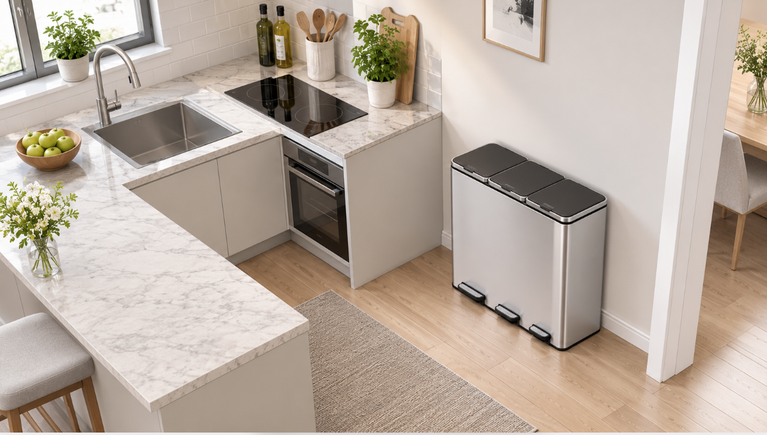
Recycling has become a regular part of household waste management, but providing separate bins does not automatically make waste separation simple.
For product buyers, the more useful question is how households organise different waste streams in the spaces they actually have.
The UK government’s latest waste statistics, updated in September 2026, report that the household recycling rate across the UK was 44.5% in 2024, compared with 44.6% in 2023.
The small decline is not enough to explain the reasons behind household recycling behaviour on its own. However, it is a reminder that waste separation remains an ongoing practical challenge, rather than a problem solved simply by introducing more recycling containers.
1. What Do the Latest UK Figures Tell Us?
The official UK statistics provide a broad picture of household waste and recycling performance.
One headline figure is the 44.5% household recycling rate in 2024. The rate was slightly lower than the 44.6% recorded in 2023.
This figure covers the UK as a whole. It should not be confused with the recycling rate of an individual local authority, city or household.
For importers and retailers, the main takeaway is not that one particular bin type is suddenly in greater demand. It is that household waste separation remains relevant to product planning, public information and everyday home organisation.
2. Recycling Depends on More Than the Bin Itself
A household may have separate containers for food waste, paper, packaging and residual waste. But the actual system also depends on collection arrangements, available space and the way residents use the containers.
Several practical factors influence the experience:
- How many waste streams need to be separated.
- Whether the home has space for multiple containers.
- How often each container needs to be emptied.
- Whether the containers are easy to identify.
- Whether the local collection system accepts the materials being separated.
This is why a recycling bin should be considered as part of a wider waste-management routine, not simply as a container with multiple compartments.
3. The Space Challenge in Homes and Apartments
Not every household has a utility room, large kitchen or dedicated recycling area.
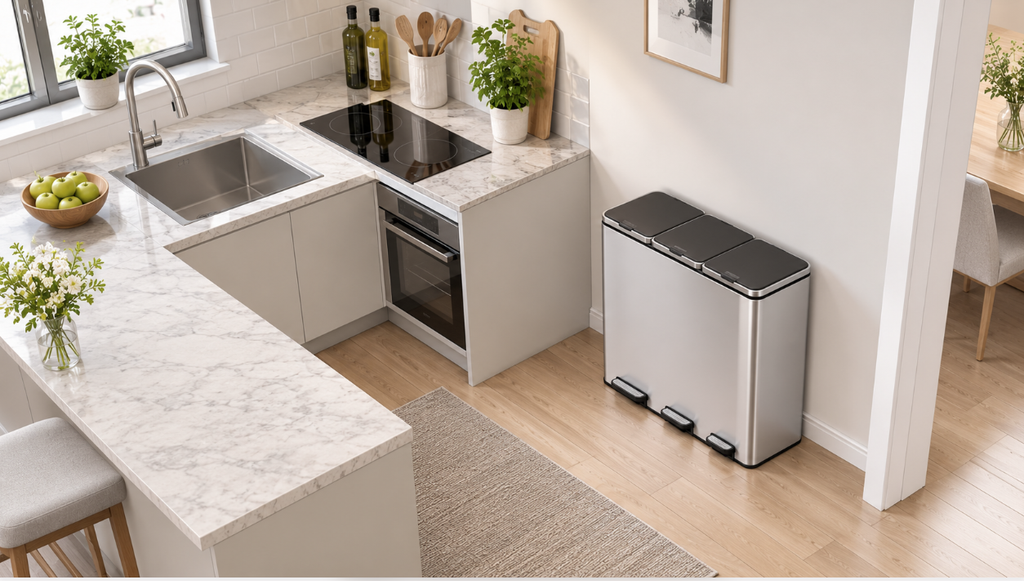
In smaller homes and apartments, users may need to place recycling containers under a counter, beside existing furniture or in a shared utility area.
This creates several product considerations:
Footprint
The bin should fit the available space without obstructing normal movement or access to cabinets.
Capacity
A container that is too small may need frequent emptying. One that is too large may occupy unnecessary space.
Separation method
Some users prefer separate containers, while others may consider multi-compartment products where the available space and waste streams make them practical.
Cleaning and maintenance
Food residue and packaging can make regular cleaning important. Removable inner containers or accessible surfaces may help with routine maintenance, depending on the product design.
4. Separate Bins or Multi-Compartment Bins?
Both approaches can be useful, but they are not interchangeable in every situation.
| Option | Potential advantages | Points to consider |
|---|---|---|
| Separate containers | Flexible placement and independent capacity for each waste stream | Requires more floor or storage space |
| Multi-compartment bin | Combines several waste streams in one product footprint | Compartment sizes may not match actual household waste volumes |
| Modular containers | Can be arranged according to available space | Users need a practical system for identifying and emptying each container |
A buyer should not assume that a multi-compartment product is always more convenient. If one compartment fills much faster than another, the overall capacity may not be used efficiently.
The right format depends on household habits, local collection rules and available space.
5. What England’s Simpler Recycling Rules Mean for Product Planning
England introduced the first phase of its Simpler Recycling requirements for household collections on 31 March 2026.
By default, waste collectors must arrange separate collection of:
- Food and garden waste.
- Paper and card.
- Other dry recyclable materials, including glass, metal, plastic and cartons.
- Residual waste.
There are some flexibilities in how certain materials may be collected together, and local arrangements can vary.
For buyers, this is an important distinction: a product range designed for one market should not automatically be treated as suitable for every local collection system.
Retailers and importers selling into England should check current local authority guidance and collection arrangements before deciding which bin configurations and labels are appropriate.
6. What Should Importers and Retailers Look for in Recycling Bins?
The latest statistics and collection changes provide a reason to review product ranges, but product selection still needs to be practical.
Useful questions include:
- How many waste streams are relevant to the target market?
- Does the intended user have enough space for separate containers?
- Are the capacities appropriate for the expected volume of each waste stream?
- Can users identify each compartment or container clearly?
- Are the containers easy to empty and clean?
- Does the product fit the local collection and sorting guidance?
- Is the packaging suitable for the intended retail or e-commerce channel?
For online sellers, clear images and descriptions are particularly important. Buyers should be able to understand how many compartments are included, their relative sizes and the product’s overall dimensions.
7. A Product Range Should Reflect Different Household Needs
There is no single recycling-bin format that works for every household.
A small apartment may need compact containers, while a larger household may prefer a higher-capacity system. Some consumers may want a dedicated food-waste container alongside a separate dry-recycling bin.
For suppliers, this creates room to offer different formats rather than relying on one universal design.
For example, a product range may include:
- Compact containers for limited spaces.
- Two-compartment bins for selected sorting needs.
- Larger recycling bins for higher-volume use.
- Coordinated products that can be placed together.
- Separate containers that allow flexible positioning.
The product range should be built around actual market requirements, not simply the number of compartments available.
Frequently Asked Questions
What was the UK’s household recycling rate in 2024?
The UK government’s latest statistics report a household recycling rate of 44.5% in 2024, compared with 44.6% in 2023.
Are England’s Simpler Recycling rules the same across the whole UK?
No. The Simpler Recycling requirements discussed here apply to England. Scotland, Wales and Northern Ireland have their own waste and recycling arrangements.
Are multi-compartment recycling bins always better?
No. They can save space in some settings, but compartment capacity and the actual mix of household waste should be considered before choosing a model.
Should recycling bins be designed around local collection rules?
Yes. Buyers should check the waste streams collected in their target market and ensure product labels and configurations are appropriate.
Final Thoughts
The latest UK recycling figures show that household waste separation remains an important issue. At the same time, the practical experience of recycling depends on space, collection arrangements, container design and everyday habits.
For importers and retailers, the opportunity is to offer recycling products that make sense for the local market and the people using them.
A useful recycling bin is not simply one with more compartments. It is one that fits the available space, supports the intended sorting routine and is easy to use and maintain.
Looking for recycling bins for your target market?
OWIN HOUSEWARE can discuss different waste-bin formats, capacities and packaging options for wholesale and private-label projects.
Email: info@owinhw.com | sales02@owinhw.com
WhatsApp / WeChat: 0085261915769
Related reading:
- [What Should Go in Each Recycling Bin? A Practical Guide to Waste Separation]
- [OWJ-I10R 60L Dual Compartment Recycling Bin]
- [How to Compare Trash Bin Supplier Quotations: A Buyer’s Guide to More Than Unit Price]
Sources: UK Government, UK Statistics on Waste, updated 23 September 2026; UK Government, Simpler household recycling rules come into force across England, 31 March 2026.