
A supplier has offered a competitive price.
The specifications look correct.
The packaging has been discussed.
The purchase order is ready.
At this point, some buyers move directly to mass production.
For standard products, this may sometimes be reasonable.
But for OEM, private-label, customized-color, retail, or large-volume orders, approving a physical sample before bulk production can reduce the chance of misunderstandings.
A sample is not only for checking whether the product “looks good.”
It can be used to confirm whether the actual product matches the written specification, commercial expectations, and approved design.
This article explains what buyers should check during trash-bin sample approval and how to turn the approved sample into a useful production reference.
1. What Is the Purpose of a Pre-production Sample?
A pre-production sample should answer a simple question:
Are the buyer and supplier looking at the same final product?
A quotation describes the price.
A specification sheet describes the requirements.
A drawing describes dimensions and construction.
But a physical sample brings these requirements together into one actual product.
For example, a buyer may specify:
30L square stainless steel pedal bin.
The sample can reveal details that are difficult to understand from a product name alone:
- Actual appearance
- Proportions
- Lid movement
- Pedal feel
- Inner bucket
- Surface finish
- Color
- Logo position
- Packaging structure
2. When Is Sample Approval Particularly Useful?
A sample is especially useful when the order involves:
- OEM
- Private label
- Custom colors
- New product development
- New supplier
- Large order quantity
- Retail packaging
- E-commerce packaging
- Multiple capacities
- A product being sold under a new brand
For a simple repeat order with an unchanged product specification, the buyer may use an existing approved sample or specification as the production reference.
The key is to have a clear reference before production.
3. Don’t Only Check Whether the Sample Looks Good
One common mistake is to treat sample approval as a visual review.
For example:
“Looks good. Approved.”
This is not enough for a technical product order.
The buyer should compare the sample against the specification.
A useful sample approval process can be divided into:
- Product identity
- Dimensions
- Material
- Construction
- Function
- Surface finish
- Color
- Branding
- Packaging
4. Check the Product Identity First
Before testing the product, make sure the sample is actually the model being ordered.
Confirm:
- Supplier model number
- Buyer SKU
- Capacity
- Product structure
- Reference drawing
- Sample version
This is particularly important when a supplier offers several similar models.
A buyer may approve one version while the PO refers to another.
The sample should therefore have a clear identification reference.
5. Check Capacity and Dimensions
Capacity should be confirmed against the agreed specification.
Depending on the project, buyers may also check:
- Overall height
- Width
- Depth
- Lid dimensions
- Inner bucket dimensions
- Product footprint
Not every buyer needs to measure every dimension.
The important point is to identify the dimensions that affect:
- Installation
- Shelf placement
- Packaging
- Shipping
- User experience
- Project space
For a hotel or office project, for example, external dimensions may matter more than they do for a general wholesale order.
6. Check Material and Thickness
If the PO specifies material grade or thickness, the sample should be evaluated against that requirement.
For example:
Body: 410 stainless steel
Thickness: 0.30–0.35 mm
The buyer should not simply approve the sample based on appearance.
For important orders, material and thickness can be included in the QC plan.
The purpose is not to make every sample inspection complicated.
It is to make sure that important specifications can be verified rather than assumed.
7. Test the Lid and Pedal
For a pedal bin, the opening mechanism is one of the most important functional areas.
Check:
- Pedal movement
- Lid opening
- Lid closing
- Alignment
- Stability
- Noise
- Soft-close function where specified
If the product has a soft-close lid, check whether the sample behaves consistently with the agreed specification.
Do not evaluate only the first opening.
Open and close the lid several times to observe whether the mechanism behaves consistently.
8. Check the Inner Bucket
If a removable inner bucket is part of the specification, test it.
Check:
- Is it included?
- Can it be removed easily?
- Does it fit correctly?
- Is it stable inside the outer body?
- Is the material correct?
- Can a waste bag be installed as intended?
For a product intended for frequent commercial use, these details can affect daily maintenance.
9. Check the Base and Stability
Place the sample on a flat surface.
Check:
- Does it stand level?
- Does it wobble?
- Does the pedal remain stable?
- Does the lid movement affect the stability?
- Is the base consistent with the approved design?
This is a simple test, but it can identify issues that are difficult to see from product photos.
10. Check Surface Finish and Color Under Normal Lighting
Color should ideally be checked under conditions similar to the final application.
For example, a color that looks acceptable under factory lighting may appear different under retail or indoor lighting.
For powder-coated products, check:
- Color
- Surface consistency
- Visible defects
- Coverage
- Scratches
- Edges and corners
For brushed stainless steel, check whether the brushing direction and appearance are consistent with the approved sample.
For fingerprint-resistant finishes, the buyer can also evaluate whether the appearance meets the intended commercial positioning.
11. Check the Logo as a Separate Item
For private-label orders, logo approval deserves its own checklist.
Confirm:
- Logo artwork
- Logo size
- Logo position
- Logo orientation
- Logo method
- Visual clarity
A logo can technically be present while still being wrong in:
- Position
- Scale
- Alignment
- Proportion
Therefore, “logo included” is not a complete approval criterion.
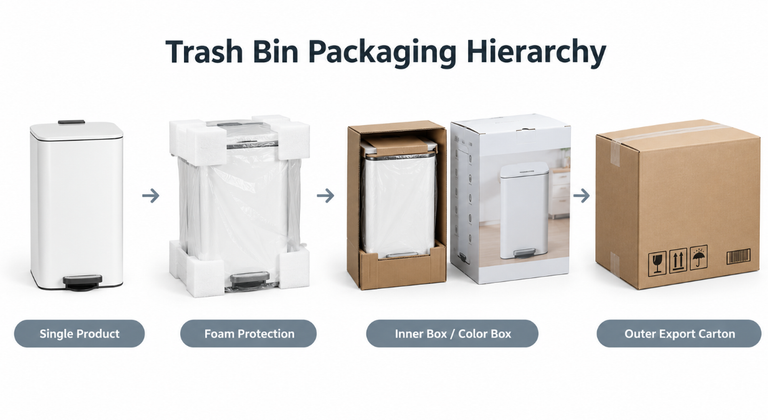
12. Packaging Should Be Sampled Too
A product sample and packaging sample do not necessarily need to be approved at the same time, but packaging should be confirmed before mass production.
For retail products, check:
- Color box
- Product image
- Brand logo
- Product information
- Barcode where applicable
- Box dimensions
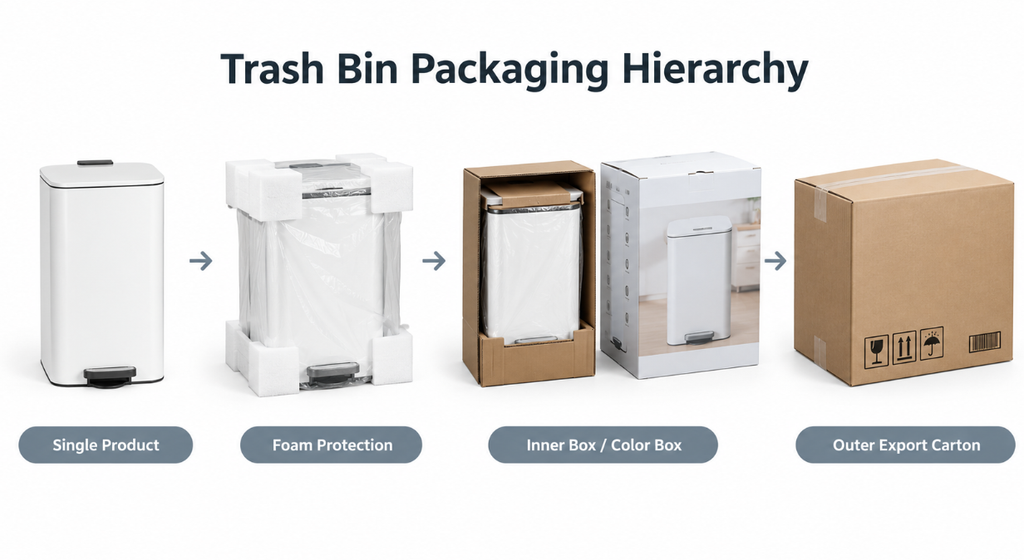
For e-commerce products, check:
- Protective foam
- Internal fixation
- Outer carton
- Drop/handling considerations
- Product movement inside the package
The goal is not to guarantee that every shipment will arrive without damage.
It is to make sure the agreed packaging structure has been clearly defined and tested where appropriate.
13. Create a Sample Approval Sheet
Instead of simply replying:
Sample approved.
buyers can create a short approval record.
For example:
| Item | Requirement | Sample Result | Status |
|---|---|---|---|
| Model | T1027 | T1027 | Approved |
| Capacity | 30L | 30L | Approved |
| Material | 410 SS | Confirmed | Approved |
| Thickness | 0.30–0.35 mm | Confirmed | Approved |
| Inner bucket | Removable PP | Confirmed | Approved |
| Lid | Soft-close | Confirmed | Approved |
| Finish | Fingerprint-resistant | Confirmed | Approved |
| Color | Black | Approved sample | Approved |
| Logo | Laser | Approved artwork | Approved |
| Packaging | E-commerce | Approved structure | Approved |
The exact fields should be adapted to the product.
This document can then become part of the production reference.
14. What If the Sample Needs Changes?
Do not simply approve the sample and explain changes later by email.
If something needs to be changed, record it clearly.
For example:
Sample version 01: Not approved.
Change required: Move logo 20 mm upward.
Change required: Adjust color to approved reference.
Change required: Improve lid alignment.
Then request a revised sample where the change is important to the final product.
This creates a clear version history:
Sample V1 → Revision → Sample V2 → Final Approval
15. The Approved Sample Should Become a Production Reference
Once approved, the sample should not disappear into a warehouse.
It should become part of the production control system.
The buyer can keep:
- Approved sample
- Final specification sheet
- Approved artwork
- Approved color reference
- Approved packaging design
- Final PO
Together, these documents create a clearer definition of the order.
The production team and QC team can then refer to the same information.
16. Sample Approval Does Not Replace Inspection
This is an important distinction.
A sample confirms:
What the buyer expects.
Inspection confirms:
Whether the mass-produced goods match that expectation.
These are not the same thing.
A good procurement process can therefore look like:
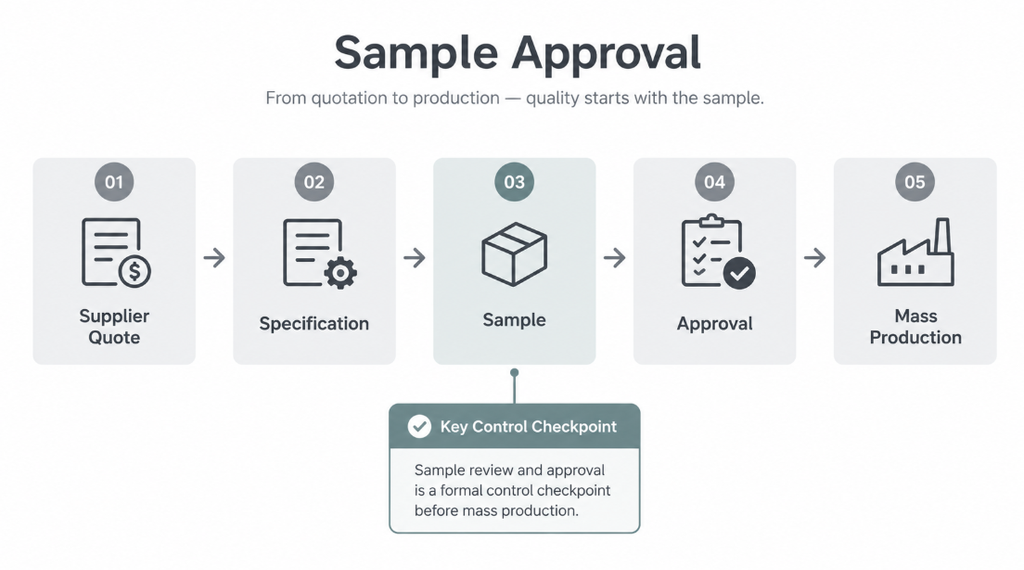
Specification → Sample → Approval → PO → Production → Inspection
For larger or customized orders, this provides multiple points of control.
17. Common Sample Approval Mistakes
Mistake 1: Approving by photo only
Photos cannot show every material, functional, or construction detail.
Mistake 2: Saying “Looks Good”
This does not create a measurable approval record.
Mistake 3: Ignoring packaging
A product may be approved while the packaging remains undefined.
Mistake 4: Changing specifications after approval
Changes should be recorded and re-approved when they affect the final product.
Mistake 5: Approving one size and assuming all sizes are identical
A product family may share the same design but have different capacity-related specifications.
Mistake 6: Not keeping the approved sample
If a dispute occurs later, the buyer needs a reference.
18. A Practical Trash Bin Sample Approval Checklist
Product
- Correct model
- Correct capacity
- Correct dimensions
- Correct material
- Correct thickness where required
Construction
- Lid
- Pedal
- Inner bucket
- Base
- Stability
Appearance
- Surface finish
- Color
- Scratches/dents
- Edges and corners
Branding
- Logo method
- Logo size
- Logo position
- Artwork
Packaging
- Individual packaging
- Protective material
- Retail box if applicable
- Export carton
- Product movement inside package
Documentation
- Specification sheet
- Approved artwork
- Approved color reference
- Approved sample
- Final PO
19. Final Takeaway
A pre-production sample is not simply a chance to see whether a trash bin looks attractive.
It is a practical control point between:
Supplier quotation → Product specification → Mass production
The most useful sample approval process checks the areas that can affect the final order:
Capacity → Material → Thickness → Construction → Function → Finish → Color → Logo → Packaging
Once the sample is approved, the buyer should preserve the approval record and use it together with the final specification and PO.
This makes the production requirement clearer for everyone involved.
For customized or large-volume orders, a few hours spent on structured sample approval can be much more useful than trying to solve specification misunderstandings after mass production has started.
Need Help With Sample Approval?
If you are developing or sourcing a new trash bin model, private-label product, or customized commercial bin, you can send us your target specifications and we can discuss which items should be confirmed before bulk production.
Email: info@owinhw.com | sales02@owinhw.com
WhatsApp / WeChat: 0085261915769