
If you sell household bins into the EU, UK, or Australia, you’ve probably seen the same pattern play out: a customer buys a “normal” 20–30L step bin, leaves a five-star review for a week, and then comes back with the one-star reality of life with toddlers.
Overflow. Sticky liners. Odor. More bag changes than they expected. And the worst one—kids stepping on the pedal for fun and scattering trash across the kitchen floor.
For families with 2+ young kids, the kitchen bin isn’t a small accessory. It’s a daily-use tool under unusually high load. And that’s why 40L–60L pedal bins aren’t a nice-to-have—they’re the size range that prevents predictable failure modes.
This article is written for wholesalers, distributors, and private-label sellers who want to capture that demand without overcomplicating their assortment. If you’re trying to rank for terms like “large pedal bin for big family”, the fastest path is to explain the real failure modes of undersized bins—then show a room-by-room size plan buyers can actually use.
- Why multi-kid households create a very different waste profile than 1–2 person homes (using field-observation ranges, not made-up “studies”)
- What makes a 60L stainless step bin (or 50L) the practical kitchen default for this segment
- A whole house bin set wholesale size matrix, so you can stock one coherent series and cover every room
- What to verify in build, hinges, inner buckets, and packaging—so you don’t absorb return-rate pain later
The multi-kid waste profile: why 30L fails fast
For a 1–2 person household, a 20–30L pedal bin can often last 2–3 days before it’s full.
For a family with multiple young kids (roughly 0–7 years old), the waste mix is different:
- Higher share of wet waste (food scraps, leftover toddler meals)
- High-volume packaging (snack wrappers, wipes, refill pouches)
- Diaper waste (in many homes, even if it’s not every day)
Based on industry observation from household-goods buyers and retailers, it’s common to see multi-kid homes generating roughly ~2 to 2.7× the daily kitchen waste volume of a single or couple household.
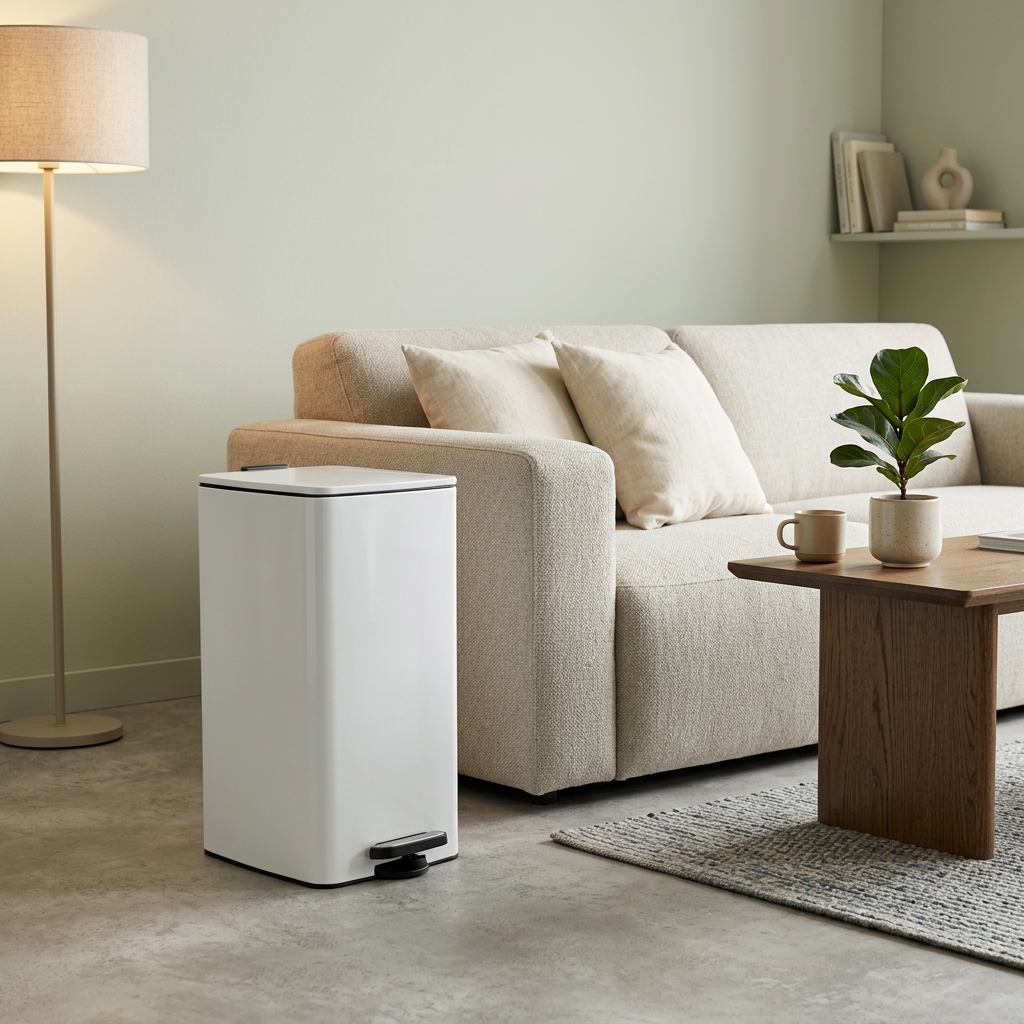
When you put that load into a 30L bin, three predictable outcomes happen:
- More bag changes: Many households end up changing bags 1–2× per day.
- More odor incidents: Wet waste gets compressed earlier, and leakage becomes a complaint.
- More mess events: Overfilled liners slip, lids don’t close, and kids interact with it.
If you’re selling into family-heavy demographics (suburbs, larger homes, multi-child households), stocking only mid-size bins means you’re leaving demand—and margin—on the table.
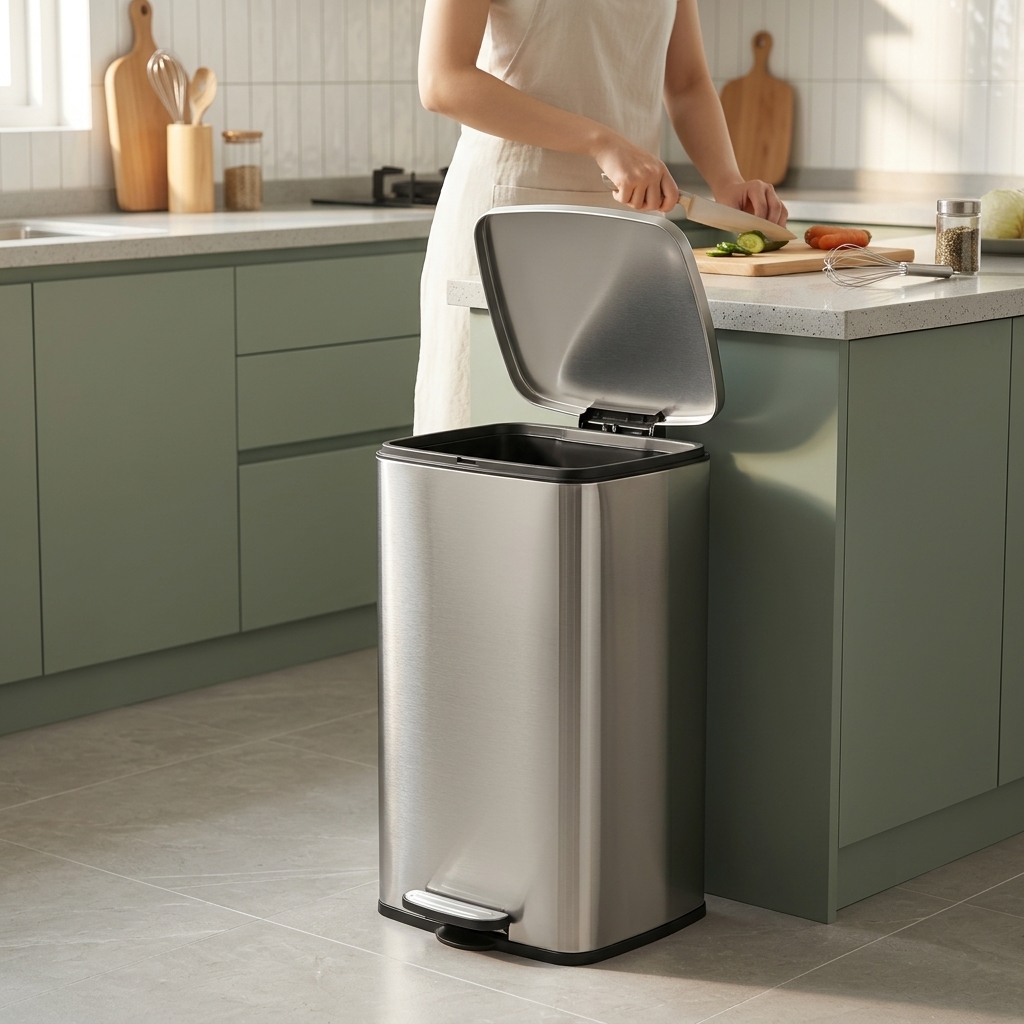
Why 40L–60L pedal bins are the “non-negotiable” kitchen range for 2+ young kids
A kitchen bin for a multi-kid family has to solve four problems at once: capacity, hygiene, safety, and noise. Practically, that’s why a 40L–60L range is the most defensible recommendation—and why searchers looking for a trash can for families with multiple kids often end up buying bigger than they originally planned.
1) Capacity that reduces household friction (and review risk)
The simplest value proposition is also the most measurable: a bigger bin reduces the number of bag changes.
- In many multi-kid households, 50L–60L supports a more realistic cadence (often every 1–3 days depending on cooking habits), versus “half-day full” frustration in 20–30L.
- More internal height also reduces liner collapse from bulky packaging and keeps wet waste from riding up into the lid area.
For procurement teams and sellers, the implication is direct: capacity is not just a feature—it is a return-rate control lever.
2) Hygiene: wet waste, liner stability, and controlled lid closure
Large families don’t just generate more trash—they generate more wet trash.
That’s why two design elements matter more than glossy marketing:
- A secure liner ring/retainer so the bag doesn’t slide down as weight increases.
- A lid that closes consistently (no sloppy bounce) so odor containment is predictable.
If you’ve ever had a customer complain “the bag keeps falling in” or “the lid doesn’t shut anymore,” you’ve seen what happens when a bin isn’t designed for high-load daily use.
3) Kid interference and tip-over risk
With toddlers, the bin is not treated like a bin. It’s a toy, a pedal, and sometimes a hiding spot.
When the bin is too light or the base is narrow, common household incidents include:
- a child stepping repeatedly on the pedal and holding the lid open
- tipping the bin over while pulling on the liner
- the bin sliding on tile when the pedal is pressed hard
This is why bigger capacity often correlates with a more stable footprint and higher overall weight, which is a practical safety and cleanliness advantage.
⚠️ Warning: If you’re selling low-cost, thin-gauge large bins without stable base geometry, dents and deformation during transit (or even in-home) quickly turn into “arrived damaged” claims—especially in e-commerce.
4) Hands-free, quiet operation fits real family routines
In homes with young kids, the kitchen is rarely calm. That changes what “good design” means.
- Hands-free pedal operation reduces contact when hands are messy from cooking or childcare.
- Soft-close / damped lids matter more than many buyers expect: slamming lids are a repeated complaint, and noise matters during naps.
A soft-close hinge also tends to reduce long-term wear from repeated impact.
50L vs 60L: which size should you recommend (and why the answer is operational)
For wholesalers and Amazon sellers, the question isn’t only “what’s the best size?” It’s “what size reduces the most complaints for the most households?”
Here’s a practical, buyer-ready guideline:
- 50L is often the safest “large family default” when buyers need a big bin that still fits more kitchens.
- 60L is ideal when the buyer’s kitchen footprint allows it and when the household has very high packaging/wet-waste load.
If your listing or line card needs the exact phrase, position it plainly: a 60L stainless step bin is the right anchor SKU for multi-kid kitchens where daily overflow is the main complaint.
This logic is consistent with mainstream consumer guidance from established European bin brands that explicitly recommend 50L or 60L for large families (useful as an external benchmark when explaining the category to buyers).
For example, Brabantia’s consumer guidance notes that for large families they recommend a 13-gallon (50L) or 16-gallon (60L) model; see Brabantia’s pedal bin guidance.
That benchmark helps buyers understand the size logic—your advantage, as a factory-direct program, is offering the same practical capacity guidance with more controllable specs and pricing than retail-brand price points.
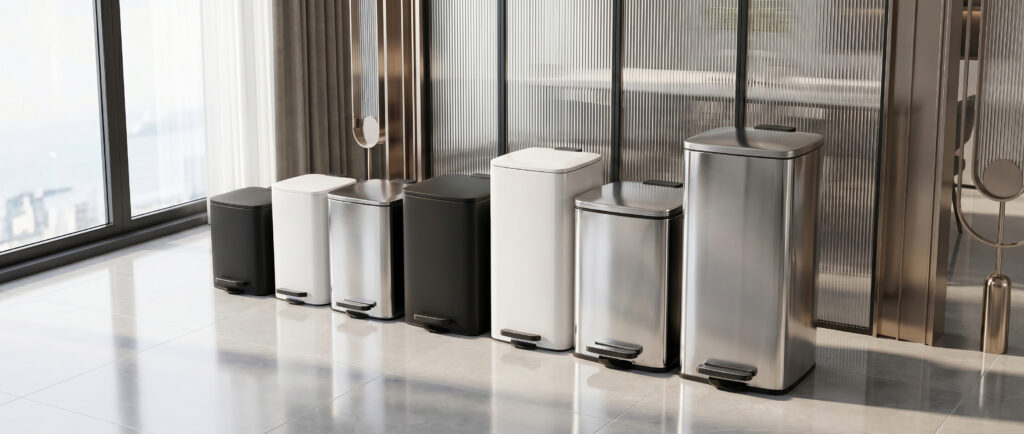
The whole house bin set wholesale play: size-matching by room (and how to stock it)
A mistake many buyers make is treating bins as one-off purchases. In reality, households don’t buy “a trash can.” They buy a system—kitchen, bathrooms, bedrooms, laundry.
That creates an opportunity: a consistent-looking series across sizes enables set bundling (“whole house set”) with higher AOV and cleaner merchandising.
Room-by-room capacity matrix (6L–60L)
Below is a sizing framework you can use in wholesale planning. It’s intentionally simple—procurement teams don’t want a 40-row spreadsheet when they’re deciding what to put in a container.
| Room / zone | Typical waste type | Recommended capacity | Why this size works | Retail/bundle role |
|---|---|---|---|---|
| Main kitchen (2+ young kids) | Wet waste + packaging + diapers (sometimes) | 40L / 50L / 60L | Avoids daily overflow; better liner stability; reduces odor incidents | High-margin hero SKU |
| Secondary kitchen / pantry | Packaging, dry waste | 30L | Fits tighter spaces; still avoids “too small” complaints | Volume SKU |
| Living room | Snack wrappers, paper waste | 20L / 30L | Enough capacity without dominating the room | Volume SKU |
| Bathroom | Tissues, hygiene waste | 12L / 16L | Right-size for daily use; easy to clean | Add-on SKU |
| Laundry / utility | lint, packaging, cleaning wipes | 12L / 16L / 20L | Flexible placement; fits utility layout | Add-on SKU |
| Kids’ bedroom / desk area | small dry waste | 6L / 8L | Compact; encourages tidy habits; low-floor-space | Bundle filler SKU |
How to turn a size line into a “whole-house set” offer
For a wholesale buyer, the advantage of a full-size series isn’t only marketing. It’s operational:
- Consistent aesthetic = easier merchandising and set photography
- One supplier = fewer spec mismatches across finishes and hardware
- Standard packaging approach = fewer transit surprises
Two set examples you can list as ready-made bundles:
- 3-piece “Family Starter Set”: 6L (kids’ room) + 12L (bathroom) + 50L (main kitchen)
- 5-piece “Whole House Set”: 6L + 8L + 12L + 16L + 60L (room allocation depends on buyer profile)
If your customers are Amazon sellers, these sets also create defensible listing differentiation: you’re not competing on a single SKU price; you’re selling a curated room system.
Where OWIN HOUSEWARE’s T1027 full-size series fits (6L–60L)
When your goal is to stock a coherent series across multiple capacities, the risk is that smaller sizes get “de-featured” compared to the hero kitchen bin.
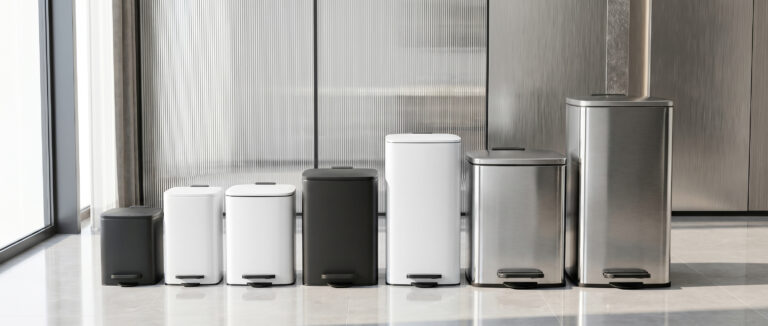
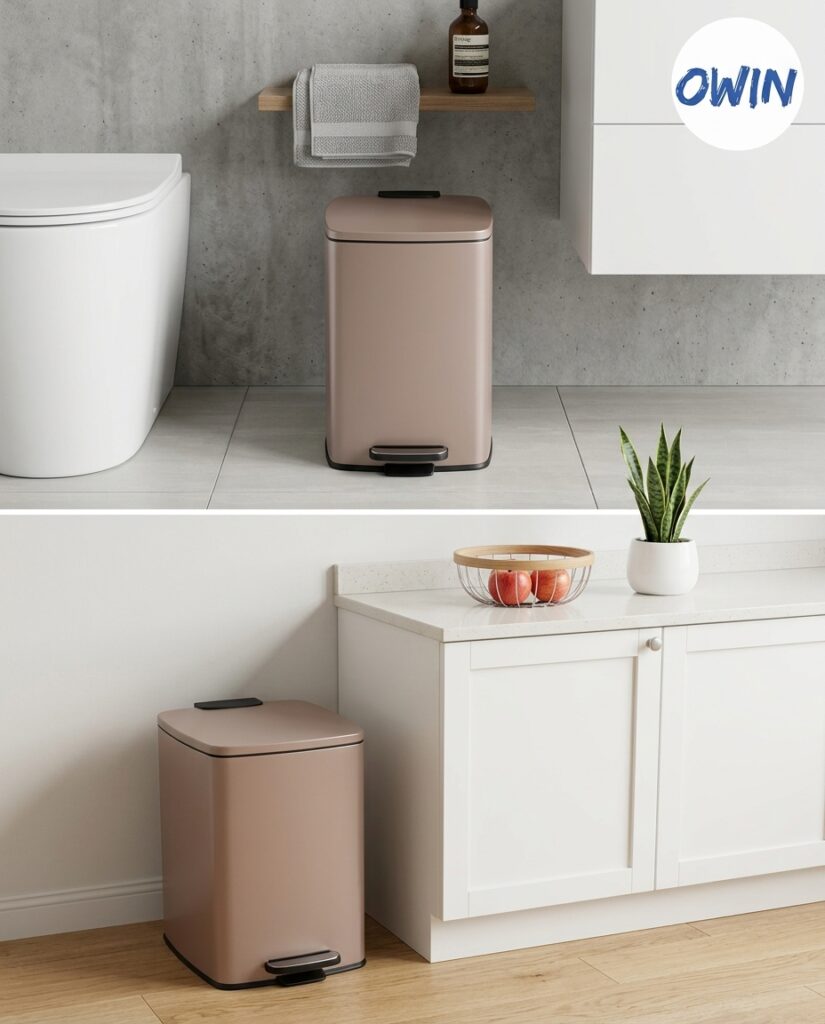
OWIN HOUSEWARE’s T1027 is a square pedal bin series built as a full size ladder from 6L to 60L, with the structure engineered differently by capacity (instead of using one thin spec for every size).
Clear product form and graded 410 stainless thickness
T1027 uses 410 stainless steel with capacity-based thickness to balance cost and real-world dent resistance:
- 6L–30L: 0.3–0.35mm 410 stainless steel
- 40L / 50L / 60L: upgraded 0.4–0.45mm 410 stainless steel to better resist impact and denting in large-family kitchens where the bin sees higher daily load
This graded thickness approach is a practical engineering choice versus many budget “one-spec-fits-all” bins: you protect the large-capacity models where dent claims are most common, without forcing unnecessary cost into smaller sizes.
Unified base design and stable supply for wholesale programs
Across the full range, T1027 is built around a fully sealed base to help block moisture and dust from entering the bottom cavity—supporting longer service life in daily-use family settings.
For buyers building an ongoing assortment, the factory also supports stable year-round bulk supply with sufficient capacity, reducing the risk of out-of-stock gaps during peak selling seasons.
Consistent build logic across sizes
The intent of a full-size line like OWIN HOUSEWARE’s T1027 series (6L–60L) is to maintain consistent build logic across sizes:
- steel-body pedal-bin construction
- removable inner bucket for cleaning
- liner management design
- soft-close / damped lid behavior (as a standard expectation in family homes)
Because your market emphasis is EU/UK/Australia, you can also merchandise finishes in a more deliberate way:
- Brushed stainless: classic look, broad acceptance in offline retail and mid-tier price points
- Fingerprint-resistant: better for e-commerce “unboxing + daily use” expectations; fewer visible smudges in customer photos and reviews
The point isn’t to claim one finish is “better.” It’s to give buyers a clean way to segment price tiers without fragmenting the product line.
What actually causes returns in this category (and what to verify before you commit)
Most procurement pain in bins isn’t from the first week of use. It’s from the second month—when hinges loosen, pedals feel sloppy, or the unit arrives dented.
Here’s a verification checklist you can use when evaluating any supplier’s 40L–60L step bins.
1) Hinge + pedal durability (soft-close isn’t just “nice”)
Multi-kid households create high-frequency open/close cycles. If a hinge design can’t handle repeated use, the first symptom is usually noise—then misalignment.
What to ask a supplier for:
- whether the soft-close damper is standard across sizes
- hinge fatigue testing approach (even if they can’t share proprietary details)
- after-sales policy for hinge/pedal complaints
2) Liner retention and rim design
A “big bin” that can’t keep a liner stable becomes an odor and mess complaint.
Verify:
- presence of a liner ring/retainer
- whether the ring actually clamps the bag edge (not purely decorative)
- how the rim is formed (sharp edges create user complaints and tear bags)
3) Inner bucket: removable and easy to clean
If you sell to families, assume the inner bucket will get dirty. The question is whether it’s easy to remove, rinse, and reset.
A removable PP inner bucket with a handle is a simple but meaningful hygiene feature—especially in 50L/60L sizes where nobody wants to carry the full bin to the sink.
4) Packaging standard (this is where e-commerce profit is made or lost)
Large stainless bins are transit-sensitive. A dented lid or scratched body triggers returns even if the bin works fine.
For 30L and above—especially the 40L/50L/60L kitchen models aimed at multi-kid homes—a stronger, purpose-built protective pack is the most practical way to reduce “arrived damaged” claims.
A recommended e-commerce packaging standard is:
- PP protective film wrap (single unit)
- Full top-and-bottom foam buffering (single unit)
- Independent 5-layer K=K courier carton (single unit)
This combination protects corners, lid edges, and the steel body during ocean freight plus last-mile courier handling, significantly reducing dents, scratches, and packaging-caused breakage—so you cut negative reviews and after-sales claims at the source.
If a supplier ships 60L bins in a thin carton with minimal internal protection, you aren’t buying “a bin.” You’re buying future claims.
Stocking and pricing: a simple assortment strategy that doesn’t blow up your warehouse
You don’t need 30 random bin models to cover demand. You need a coherent size ladder.
Here’s a proven way to structure it for margin and volume:
- 6L–16L: entry and add-on sizes (bathroom, desk, kids’ room) — useful for sets
- 20L–30L: high-volume general sizes — living room, small kitchens
- 40L–60L: profit SKUs — large families’ main kitchen bins
This structure lets you:
- keep photography and merchandising consistent
- reduce SKU chaos by using one family of products
- bundle sets without forcing buyers to mix unrelated styles
Pro Tip: Don’t treat 60L as a “one-off hero SKU.” Your margin improves when it’s bundled with 1–3 smaller sizes that share the same look and packaging standard.
Procurement pitfalls (what experienced factories see go wrong)
If you want fewer unpleasant surprises, avoid these common mistakes:
- Ordering only the biggest size
- A single 60L SKU is harder to merchandise and often increases shipping friction. Sets spread logistics cost and increase AOV.
- Choosing low-cost bins without soft-close for high-frequency households
- Multi-kid homes stress hinges and pedals. Without controlled closure, noise and wear complaints tend to rise.
- Ignoring steel rigidity and deformation risk
- Thin bodies dent easily in ocean freight and courier networks. The cost shows up later as claims and negative reviews.
- Under-specifying packaging for large stainless bins
- If you sell online, packaging is part of the product. Make foam and carton standards a line-item requirement, not an afterthought.
FAQ
What T1027 size works best for a family with 3 young kids?
T1027 50L or 60L is ideal for the main kitchen. Pair it with 6L for kids’ bedrooms and 12L for bathrooms to form a practical whole-house set.
What’s the stainless steel thickness of T1027 square pedal bins for different capacities?
The T1027 square pedal bin series uses graded 410 stainless steel: 0.3–0.35mm for 6L–30L, and upgraded 0.4–0.45mm for 40L/50L/60L large-capacity models to better resist impact and denting. All versions come with a fully sealed base.
Does the whole T1027 line come with soft-close pedal lids?
Yes—from 6L up to 60L, the series is positioned as a consistent line for stocking and set building, including soft-close expectations and removable PP inner buckets.
What’s the MOQ of T1027 series? Can I get free samples and the latest price?
The MOQ for the T1027 full series is 200 units, and mixed sizes are allowed for trial orders. You can contact the sales team to apply for free samples and request the newest official quotation.
Can I mix multiple T1027 sizes in one FBA shipment with the same packaging standard?
Yes. For e-commerce safety, the practical standard to confirm is consistent foam buffering plus a reinforced outer carton across sizes. This is especially critical for 40L–60L units.
Is custom private label logo available across the full T1027 series?
Yes. Laser logo engraving can typically be applied across sizes, and mixed-size trial orders are a common way to validate finish and packaging before scaling.
Next steps
If you want a fast, low-risk way to build a profitable family-bin assortment, start with a clear size ladder and verify the few things that actually drive returns: hinge behavior, liner retention, and packaging.
If you’re evaluating OWIN HOUSEWARE’s T1027 square pedal bin series (6L–60L), here’s a straightforward way to move forward:
- Low MOQ for starting programs: MOQ is 200 units for the full series, and mixed sizes are allowed for trial orders.
- Sample support: Contact our sales team to apply for free samples so you can verify steel thickness, soft-close performance, and protective packaging in hand.
- Market timing: T1027 is currently selling strongly with favorable factory pricing. Enquire to receive the newest official quotation.
- Complete delivery documents: Full-size PDF specification sheet (dimensions by capacity), carton info & CBM, graded wholesale price ladder, channel-specific stocking suggestions for EU / UK / Australia (retail vs e-commerce), plus a full set of CE material test reports.
- Service commitment: We reply to procurement enquiries within 24 hours to help you avoid avoidable risks such as transit damage claims, high return rates, and slow-moving inventory.
Contact:
- Email: info@owinhw.com / sales02@owinhw.com
- WhatsApp / WeChat : 0085261915769
Learn more about OWIN HOUSEWARE: