
Mandatory household waste separation isn’t “nice to have” anymore across much of the UK/EU, Australia, Canada, and parts of the US West Coast—it’s a day-to-day kitchen behavior. That’s exactly why the category looks attractive to wholesalers… and why so many importers still lose money on it.
The hidden profit killer is predictable: buyers overstock wide, multi-compartment, thin-gauge bins that look great in photos but fail in real kitchens. End users complain they don’t fit the footprint, they’re frustrating to wash, lids slam, odors linger, and shipping dents show up on doorsteps. The outcome is brutal for B2B buyers: returns, negative reviews, suppressed listings, and dead inventory.
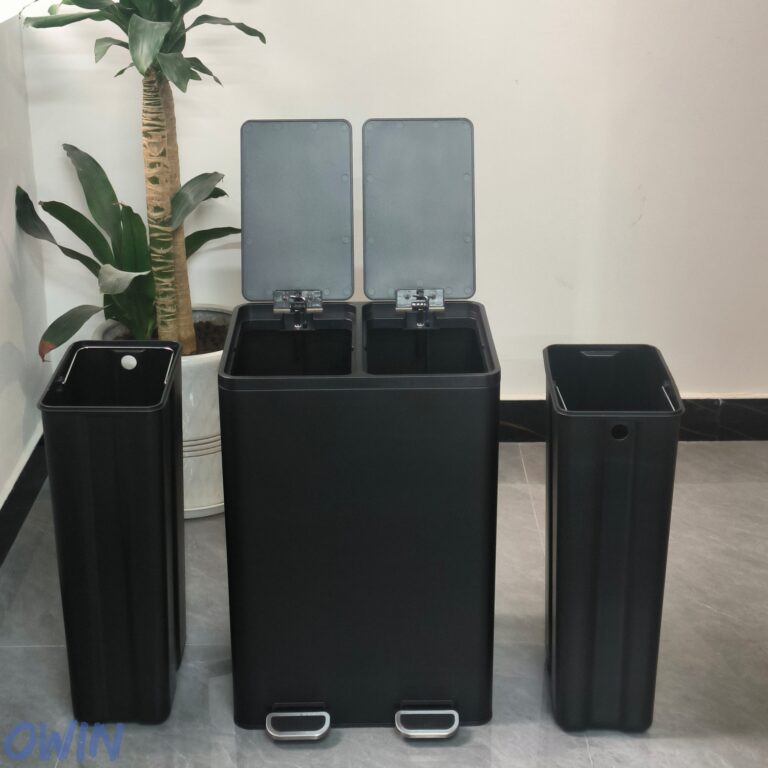
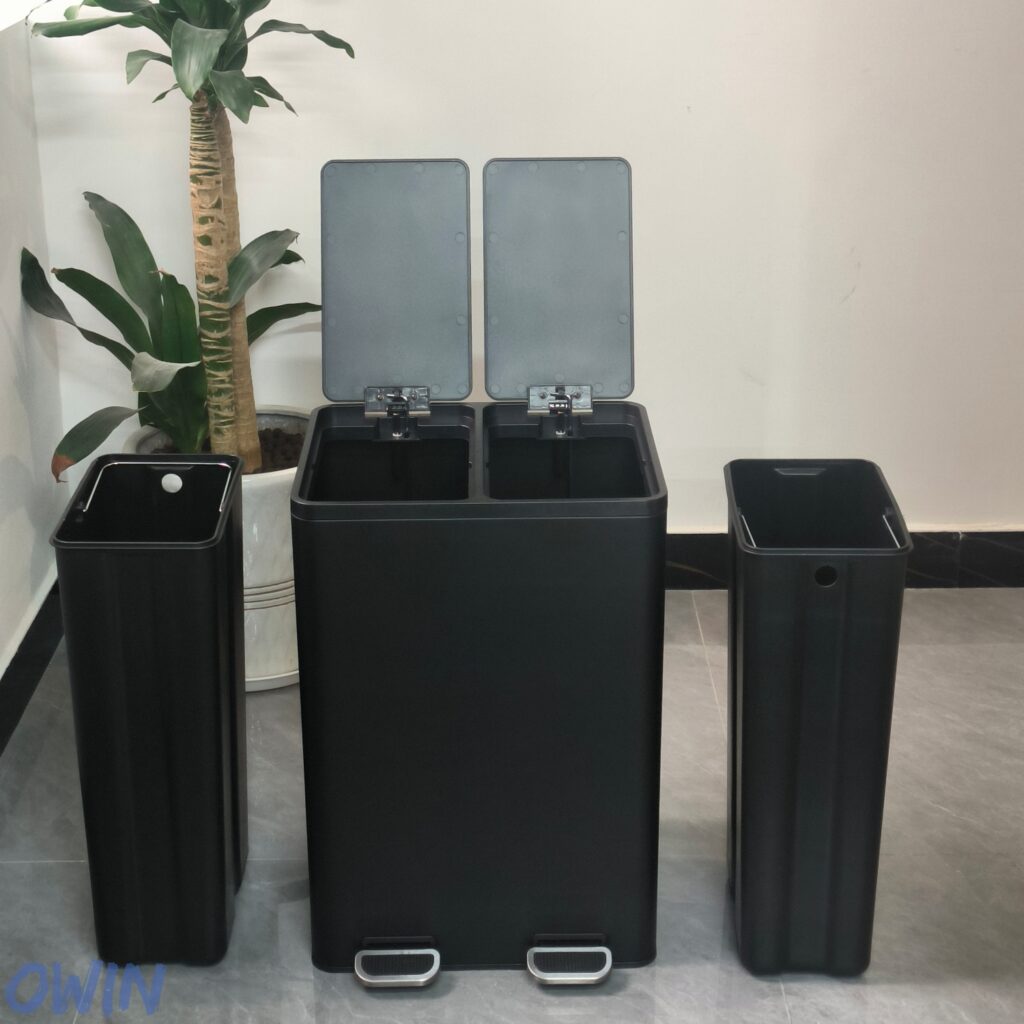
This article breaks down the logic behind the kitchen format that consistently sells with fewer headaches—then uses OWIN’s T2010 as a real, parameter-level example of what “low return-rate design” looks like for a kitchen recycling bin.
1) Why the kitchen only needs two streams (and why extra compartments backfire)
In real household kitchens, daily waste separation almost always collapses into two practical streams:
- Wet food waste / organics (peelings, leftovers, coffee grounds)
- Dry recyclables (clean paper/cardboard, bottles, cans, and other dry packaging)
Even when municipalities collect multiple categories, the kitchen is where behavior has to stay simple. If sorting feels complicated or the bin layout doesn’t match the space, people stop using the “extra” compartments—and those unused sections become the source of complaints: smells, leaks, and cleaning frustration.
That’s why a dual compartment kitchen bin tends to outperform 3- or 4-compartment designs in the kitchen:
- Higher consistency: two decisions are easier than four.
- Less contamination: separating food waste helps keep dry recyclables clean (a recurring theme in recycling guidance such as JB Recycling’s explanation of why food waste doesn’t belong in recycling).
- Better fit: kitchens have fixed cabinet widths, narrow traffic lanes, and awkward corners—wide bodies are a sell-through risk.
Bottom line: if you’re building a stable “kitchen” assortment for mandatory-separation markets, dual-compartment is the lowest-risk mainstream format.
2) Footprint is the first filter for a kitchen recycling bin
Online listings can hide a bad footprint. Kitchens can’t.
If the bin is too wide, it blocks drawers, fights with cabinet doors, or gets pushed into an inconvenient corner. And when a product is inconvenient, it’s not “less loved”—it’s returned.
What works better for the category is a slim kitchen waste sorter approach:
- Narrow, stable front profile
- Vertical capacity (height) instead of width
- Geometry that can sit beside a cabinet run, under a counter edge, or in a small apartment layout
This is also where many multi-compartment bins fail: each added compartment usually adds width, not usability.
3) The sell-through details most listings don’t explain (but reviews always expose)
A kitchen bin isn’t judged by its hero photo. It’s judged by the first month of use.
Here are the design details that consistently decide whether a kitchen sorting bin becomes “easy to live with” or a review problem.
Easy-clean interior geometry: smooth transitions, fewer dirt traps
Most “hard to clean” complaints come down to geometry.
- Sharp corners trap residue.
- Complex seams hold moisture.
- Flat edges create wipe-down friction.
A cleaner interior is a return-rate reducer. In practice, the goal is to minimize dead angles so grease and food residue don’t hide.
Removable PP inner buckets: the simplest way to reduce mess (and complaints)
If the user can’t lift out the dirty part, they’ll wash the whole bin—or they won’t wash it at all.
A bin that includes independent, removable PP inner buckets makes two things easier:
- Emptying one stream without touching the other
- Washing the bucket directly in a sink or with running water
For B2B buyers, this matters because “easy cleaning” isn’t a feature claim—it’s a customer-retention mechanic.
Quiet lid mechanics: a “soft-close” isn’t a luxury in a high-traffic kitchen
In kitchens, lids open and close dozens of times a day. If the lid slams, it becomes a daily annoyance—and the annoyance turns into a low-star review.
A soft close recycling bin design reduces:
- impact noise
- lid bouncing
- long-term hinge stress from repeated hard stops
Odor and fruit-fly control: sealing and fit matter more than capacity
Food waste is the reality of the category. Odor complaints happen when the lid doesn’t seat well, or when gaps allow air exchange that carries smell.
Good odor control is mostly structural:
- lid-to-rim fit
- consistent closing behavior
- proper separation so organics don’t contaminate dry recyclables
Key Takeaway: In this category, low return rates come from structure, cleaning, and pack-out—not from styling.
4) T2010: a parameter-level example built for wholesale + e-commerce
Below is a worked example of how these principles show up in a single SKU designed for kitchen-only sorting.
Two sizes to cover real kitchens (without overbuilding your SKU list)
- 30L: 40.7 × 37 × 41.7 cm (small apartments, narrow spaces)
- 40L: 40.7 × 37 × 59.1 cm (family kitchens, higher daily volume)
This “same footprint, different height” approach helps you cover a wide market without gambling on wide-body formats.
Materials and thickness (specified, not implied)
- Body: 410 stainless steel, 0.4 mm
- Lid: 410 stainless steel, 0.45 mm (thicker for wear resistance)
- Inner buckets: food-grade PP, removable
410 stainless steel is ideal for indoor kitchen environments due to its excellent hardness, scratch resistance, and cost-performance. Unlike outdoor-grade 304, 410 steel provides sufficient anti-rust performance for dry indoor use while keeping wholesale pricing competitive for mass-market kitchen assortments.
The thicker lid design is intentional engineering: lids endure thousands of open/close cycles and friction, while the body remains static. This differentiated thickness balances durability, product weight, and shipping cost — a detail most generic suppliers ignore.
Lid and user experience
- Full soft-close lid system (quiet close, no slam)
Packaging engineered for e-commerce damage prevention
If you’re selling through marketplaces or cross-border parcel networks, packaging isn’t a cost center—it’s your review score insurance.
T2010 is packed with:
- 1 pc / PP bag (dust and scratch protection)
- Full foam protection top and bottom (anti-dent, anti-compression)
- 5-layer K=K reinforced export carton
This e-commerce-grade pack-out is designed to minimize in-transit dents and scratches, helping Amazon FBA and cross-border parcel sellers reduce returns and protect review ratings.
That configuration is aligned with general FBA durability expectations that emphasize strong corrugated cartons and sufficient cushioning so the product doesn’t shift during transit (see eFulfillmentService’s overview of Amazon FBA packaging durability requirements).
For buyers building an FBA-safe trash bin assortment, this is often the difference between scalable reviews and a slow-motion listing failure.
5) Why this is a “steady wholesale” format for mandatory-separation markets
From an importer’s profitability perspective, the strongest wholesale kitchen bin isn’t the one with the most compartments—it’s the one that keeps operations simple.
Here’s why the T2010-style approach tends to be stable:
- Assortment discipline: two sizes cover most kitchens without forcing you to stock multiple footprints.
- Material choice that matches the category: 410 stainless steel is widely accepted for kitchen use where the product design and thickness are controlled.
- Lower after-sales risk: thicker lid material and structural consistency reduce issues that trigger returns.
- E-commerce-ready pack-out: foam + K=K carton directly targets the most expensive failure mode—shipping dents and the reviews they create.
Finish options also matter for private label programs: a powder-coated finish can support custom color requirements (details and documents available on request).
6) Procurement pitfalls: how to avoid the bins that create refunds and bad reviews
If you’re sourcing an online wholesale kitchen bin for mandatory-separation markets, don’t let the listing photo drive the decision. Use a spec-first checklist.
What to verify before you place volume orders
- Steel thickness (body and lid)
- Ask for thickness by part, not one overall number.
- Lids wear faster; if the lid is thin, complaints show up early.
- Interior cleanability
- Look for smooth transitions and fewer dirt traps.
- Avoid complex corners that hold residue.
- Removable inner buckets
- Non-removable compartments turn cleaning into a pain point.
- Soft-close lid system
- In kitchens, this is a usability requirement, not a premium feature.
- Packaging standard for e-commerce
- For parcel shipping, you need immobilization + foam + a strong carton.
- Thin cartons are a predictable dent-and-return pipeline.
⚠️ Warning: A wide multi-compartment bin can look “more premium” in photos and still be the fastest route to dead inventory if it doesn’t match real kitchen footprints.
7) FAQ: Kitchen sorting bins buyers actually ask (SEO-focused)
What’s the best capacity for a kitchen recycling bin in small apartments?
For small kitchens, the best-selling approach is usually a compact footprint with moderate capacity. A 30L format that keeps the same footprint as larger sizes but reduces height is often easier to place without blocking cabinet access—and it tends to earn better reviews because it behaves like a true kitchen recycling bin instead of a bulky floor unit.
Is a dual compartment kitchen bin better than a 3-compartment bin?
For kitchens, yes in most cases. Two streams are easier for households to maintain daily, and extra compartments often create width and cleaning problems that show up as returns and negative reviews.
What makes a soft close recycling bin worth specifying in wholesale orders?
It reduces slam noise and also reduces long-term stress on hinges and lid mounts. In high-frequency kitchen use, that’s directly tied to fewer “mechanism feels cheap” review themes.
What packaging should I require if I need an FBA-safe trash bin?
Require a pack-out that immobilizes the bin and protects edges: a protective bag for surface scuffs, foam protection (especially top/bottom and corners), and a strong multi-layer export carton (commonly 5-layer) designed for drop and compression handling.
Is the T2010 bin suitable for private label and custom logo?
Yes. The T2010 dual-compartment kitchen bin supports laser logo customization and custom exterior finishes. We provide complete document support for wholesale branded programs.
Next steps: get the T2010 datasheet + QC & certification pack
Contact OWIN HOUSEWARE today to receive the complete T2010 datasheet, packaging test details, batch QC standards, and compliant certification documents. We also provide customized sizing suggestions based on your target market and support low-MOQ trial orders for new wholesale and Amazon sellers.
- MOQ: 300 pcs
- Website: www.owinhouseware.com
- WhatsApp: 0085261915769
- Email: info@owinhw.com /sales02@owinhw.com