
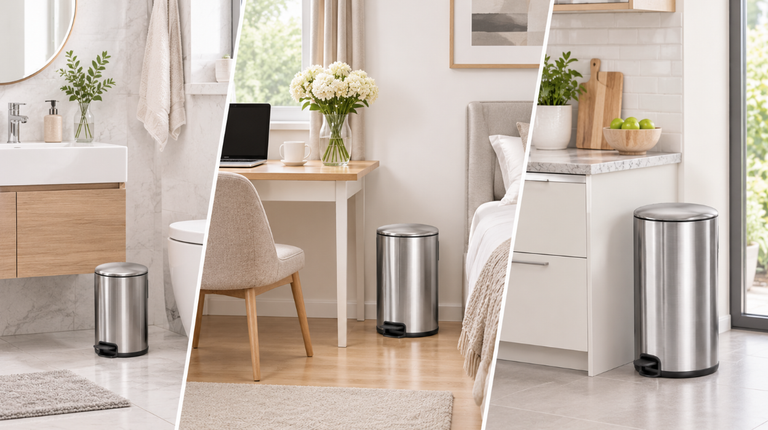
Waste bins are among the most frequently used items in shared indoor spaces. They may be small pieces of equipment, but their position, opening method and surrounding space can affect how easily people use them.
In hotels, apartment buildings, offices, healthcare-related environments and other shared facilities, buyers need to think beyond capacity and appearance.
A bin that is easy for one person to use may be less convenient for someone with limited mobility, reduced hand strength or a temporary injury. This makes accessibility and everyday usability worth considering during product selection and space planning.
This article looks at several practical points buyers can include in their waste-bin specifications.
1. Accessibility Starts with the Whole Space
When discussing accessible waste disposal, it is easy to focus only on the bin itself. In practice, usability also depends on where the bin is placed and how much space is available around it.
For example:
- Is the bin easy to approach?
- Does it obstruct a doorway, corridor or walking route?
- Is there enough room to stand or position a mobility aid nearby?
- Can users reach the opening without awkward movement?
- Is the bin placed where people naturally generate waste?
A product with a convenient opening mechanism may still be difficult to use if it is placed behind furniture or in a narrow corner.
For project buyers, the surrounding layout should therefore be considered alongside the product specification.
2. Different Opening Mechanisms Serve Different Needs
Waste bins are available with several opening designs. Each has practical advantages and limitations.
| Opening Type | Potential Advantages | Points to Consider |
|---|---|---|
| Foot pedal | Allows users to open the lid without using their hands | Requires foot movement and sufficient space for pedal operation |
| Sensor-operated | Opens without direct hand or foot contact | Requires batteries or power, and sensor performance should be checked |
| Open top | No lid operation is required | Waste is more exposed, which may not suit every environment |
| Manual lid | Simple operating structure | Requires users to lift or move the lid by hand |
No single mechanism is suitable for every user or every location.
A foot pedal can be practical for users who prefer hands-free operation, but it still requires the ability to operate the pedal. A sensor bin reduces the need for physical contact, but buyers should consider battery replacement, sensor response and maintenance.
An open-top bin avoids the need to operate a lid, although it may not be appropriate where waste needs to be covered.
The right choice depends on the intended users, the environment and the waste-disposal routine.
3. Consider Reach, Clearance and Placement
A common purchasing mistake is to select a bin based only on its height and capacity.
For shared spaces, buyers should also consider the following:
Opening height and reach
The opening should be reasonably easy for intended users to reach. The appropriate height may differ depending on whether the bin is used by standing adults, children or people using mobility aids.
Pedal clearance
For pedal-operated bins, there needs to be enough clear floor space in front of the product. A bin placed too close to a wall, cabinet or another object may be difficult to operate.
Lid movement
A lid that opens upwards needs sufficient clearance above the bin. Buyers should check whether shelves, counters or other fixtures interfere with the opening movement.
Approach space
The area around the bin should allow users to approach it without having to move other objects. This is particularly relevant in corridors, compact kitchens and shared facilities.
Location within the room
A bin should be positioned near the activity that generates waste, while avoiding unnecessary obstruction to normal movement.
These considerations are often easier to address during the layout and specification stage than after the products have been installed.
4. Match the Bin Design to the Environment
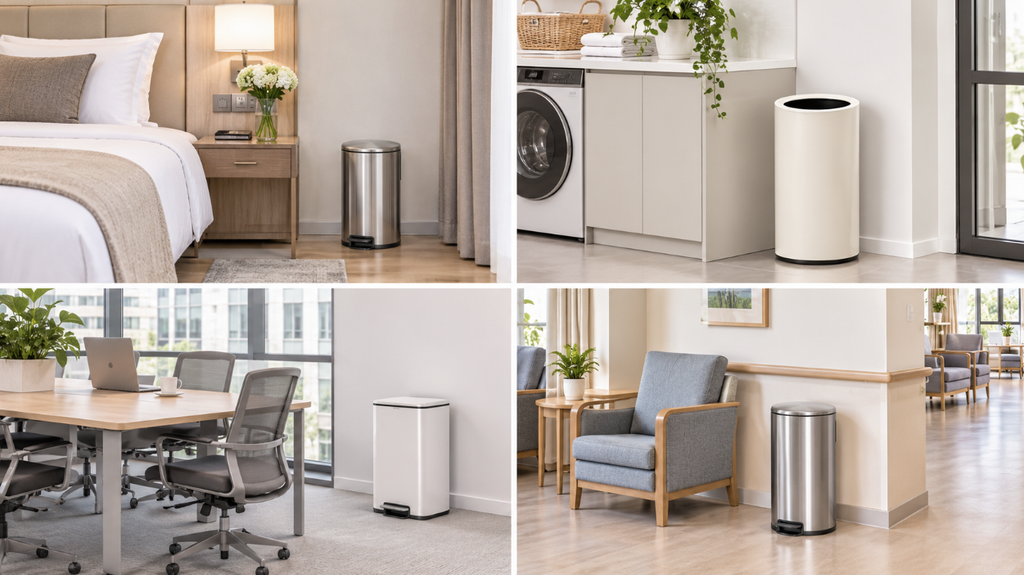
Different environments have different usage patterns. A product suitable for one location may not be the most practical choice elsewhere.
Hotels and serviced apartments
Guest rooms and shared areas have different requirements. In guest rooms, appearance, footprint and ease of use may be important. In shared areas, cleaning routines, waste volume and user traffic may have a greater influence on selection.
Residential apartment buildings
Shared kitchens, utility rooms and common areas may be used by residents with different ages and physical abilities. Clear placement and easy access should be considered when choosing bin types and locations.
Offices and meeting rooms
Office bins are often used throughout the working day. Buyers may consider whether open-top, pedal or sensor-operated designs fit the waste type, cleaning routine and expected user behaviour.
Healthcare-related and care environments
In environments serving people with different mobility or support needs, product selection should follow the facility’s own accessibility, hygiene and operational requirements. Buyers should confirm relevant local standards and project specifications rather than assuming that one general-purpose bin is suitable.
5. Accessibility and Hygiene Should Be Considered Together
Reducing unnecessary contact with a waste-bin lid can be useful in some settings, but hygiene is not determined by opening mechanism alone.
Other factors also matter:
- How frequently the bin is emptied.
- Whether the inner container can be removed easily.
- Whether surfaces are easy to clean.
- Whether the bin is suitable for the waste being collected.
- Whether staff can access the bin for routine maintenance.
- Whether the product’s location creates cleaning difficulties.
For example, a sensor bin may reduce the need to touch the lid, but it still needs regular cleaning and battery maintenance. A pedal bin may allow hands-free opening, but the pedal and surrounding floor area also need to be included in cleaning routines.
Buyers should evaluate the complete use and maintenance process rather than relying on one feature as a substitute for good hygiene management.
6. A Practical Checklist for Project Buyers
Before specifying waste bins for a shared or accessible space, buyers can use the following checklist:
- Intended users: Who will use the bin, and are there different mobility or reach requirements?
- Opening method: Is foot-operated, sensor-operated, open-top or manual access most appropriate?
- Approach space: Can users reach the bin without obstruction?
- Operating clearance: Is there enough room for the pedal or lid to move?
- Placement: Is the bin located close to the activity that generates waste?
- Waste type: Is the opening and capacity suitable for the waste being collected?
- Cleaning: Can staff empty and clean the bin without unnecessary difficulty?
- Maintenance: Are batteries, removable components or replacement parts relevant?
- Project requirements: Have applicable local accessibility and building requirements been checked?
For projects subject to formal accessibility requirements, buyers should confirm the relevant local regulations and consult the project designer or accessibility specialist. General product-selection guidance should not replace compliance checks.
7. Choosing a Suitable Waste Bin Is a Space-Planning Decision
A waste bin is a small part of a building’s equipment schedule, but it is used repeatedly by residents, guests, employees and visitors.
The most practical solution is not necessarily the bin with the largest capacity or the most advanced opening mechanism. It is the product that fits the intended users, the available space, the waste type and the facility’s maintenance routine.
For suppliers and project buyers, including these considerations early can help avoid products that look suitable in a catalogue but become inconvenient after installation.
OWIN HOUSEWARE offers different waste-bin designs, including pedal-operated and sensor-operated models, for household and selected commercial applications. Buyers can review the product range according to the requirements of their projects and distribution channels.
Frequently Asked Questions
Does a sensor bin automatically make a space accessible?
Not necessarily. A sensor bin can reduce the need to touch or operate a pedal, but its height, position, approach space and sensor response still affect usability.
Are pedal bins suitable for every shared space?
No. Pedal bins can be practical in many indoor environments, but users need to be able to operate the pedal and there must be enough clearance in front of the bin.
What should buyers check when positioning a waste bin?
Buyers should consider approach space, opening clearance, reach, nearby furniture and whether the bin obstructs normal movement.
Should accessibility requirements be included in a waste-bin specification?
Yes, where relevant to the project. Buyers should identify the intended users and confirm applicable local accessibility and building requirements before finalising the product and installation position.
Discuss Waste Bin Requirements for Your Project
If you are sourcing pedal bins, sensor bins or other indoor waste bins for a hotel, apartment, office or distribution business, OWIN HOUSEWARE can help you review suitable product options.
Email: info@owinhw.com | sales02@owinhw.com
WhatsApp / WeChat: 0085261915769
Website: https://owinhouseware.com/