
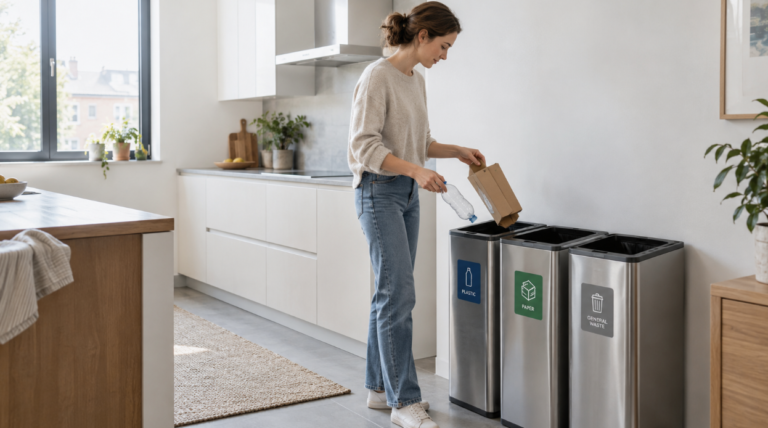
Recycling bins are becoming a familiar part of kitchens, offices and shared spaces. Yet separating waste is not always as simple as placing paper in one compartment and everything else in another.
Different local collection systems may accept different materials. Food residue, packaging combinations and unclear labels can also make sorting more difficult.
For buyers sourcing recycling bins, understanding these everyday challenges helps determine which bin layout, capacity and labelling options are suitable for their market.
1. Why Waste Separation Can Be Confusing
Many products look recyclable, but their actual acceptance depends on local collection rules and processing facilities.
Common examples include:
- Paper and cardboard contaminated with food or grease.
- Plastic packaging made from different materials.
- Containers that still hold food or liquid residue.
- Composite packaging that combines paper, plastic or foil.
- Items that are technically recyclable but not accepted by a local collection service.
This means a recycling label should not be treated as a universal instruction. Buyers, retailers and facility operators should check the local waste collection guidance relevant to the intended market.
2. Start with the Waste Streams, Not the Bin Design
Before selecting a recycling bin, identify the materials that users are expected to separate.
A simple planning table can help:
| Waste stream | Examples | What to check |
|---|---|---|
| Paper and cardboard | Office paper, clean cardboard packaging | Local acceptance rules and contamination requirements |
| Plastic packaging | Bottles, tubs and selected packaging | Accepted resin types and local collection rules |
| Metal packaging | Aluminium cans and steel food cans | Whether the collection system accepts these items |
| Glass | Bottles and jars | Whether glass is collected separately |
| Food waste | Food scraps and selected organic waste | Whether a separate collection service exists |
| General waste | Items not accepted in other streams | What remains after the required separation |
This is a planning framework, not a universal recycling standard. Actual categories should be adapted to local rules and the site’s waste contractor.
For example, a small office may need separate containers for paper and general waste, while a household kitchen may have a different set of collection requirements.
3. Is a Single Bin, Dual-Compartment Bin or Multi-Compartment Bin Better?
The right structure depends on how many waste streams need to be separated and how much space is available.
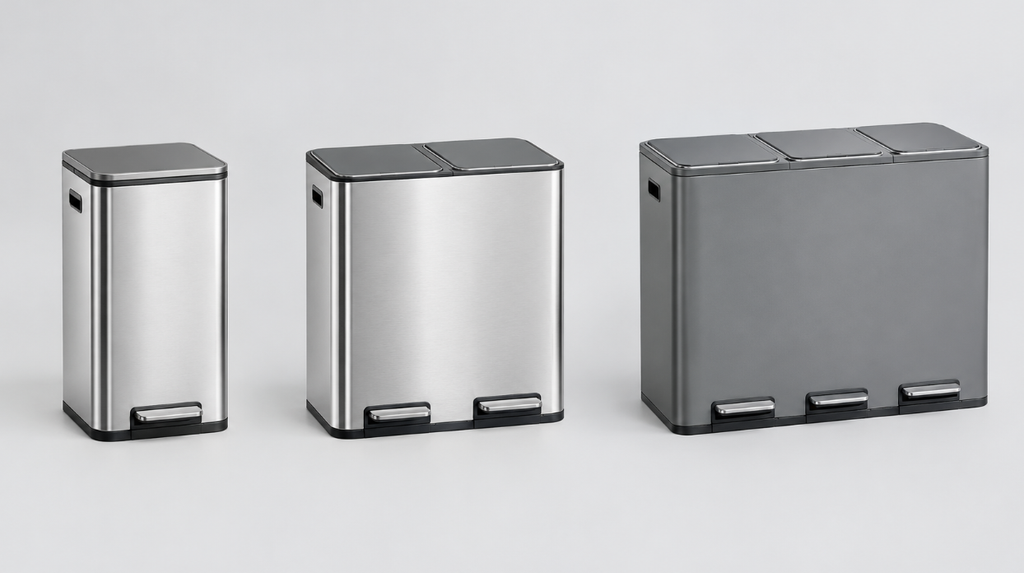
Single-compartment bins
A single bin can work where waste is collected together or where the product is intended for one specific waste stream.
Its simple structure may make it easier to place in small rooms, beside desks or in locations where several separate containers would be impractical.
Dual-compartment bins
A dual-compartment bin can combine two waste streams within one outer body. This may be useful in kitchens, offices and other locations where space is limited.
However, the two compartments need to match the site’s actual collection system. A two-compartment design is not automatically suitable for every recycling programme.
Multi-compartment bins
Multi-compartment products can support several waste streams in a shared location. They may be useful in offices, staff areas or facilities where separate collection is already organised.
Before choosing one, consider whether users can identify each opening clearly and whether cleaning staff can empty the compartments without confusion.
4. Labels and Colours Help, but They Need to Be Clear
A recycling bin may have several compartments and still be difficult to use if the labels are unclear.
Useful labels typically identify the intended waste stream in plain language. Where appropriate, simple icons or example images can help users understand what belongs in each compartment.
Before approving a label design, check:
- Whether the wording matches the local collection system.
- Whether users can read it from a normal standing position.
- Whether the examples represent materials actually accepted locally.
- Whether the label can be maintained or replaced when requirements change.
- Whether colours are consistent with the site’s established signage.
Avoid assuming that one colour scheme is used everywhere. Local guidance and existing facility signage should take priority over a generic colour convention.
For private-label products, buyers should also confirm the final artwork, language and label position before mass production.
5. Capacity Should Reflect Each Waste Stream
A common planning mistake is to choose a bin based only on its total capacity.
For a dual-compartment bin, the two compartments may fill at different rates. A household that generates large amounts of packaging may fill the recycling compartment faster than the general-waste compartment, or vice versa.
Buyers should consider:
- The number of people using the bin.
- The volume of each waste stream.
- How frequently the bin is emptied.
- Whether the compartments have equal or different capacities.
- The floor space available for the product.
Where usage patterns are uncertain, observing actual waste volumes or testing a proposed layout can provide more useful information than choosing by total capacity alone.
6. Good Sorting Also Depends on Everyday Habits
The bin itself is only one part of the process. Clear instructions and convenient placement can influence whether people use it correctly.
For example:
- Put the bin near the activity that generates the waste.
- Use straightforward labels rather than long explanations.
- Avoid placing similar-looking openings too close together without clear identification.
- Keep the bin accessible without obstructing movement.
- Explain local sorting rules to staff or users where needed.
For workplaces and commercial properties, cleaning and waste collection teams should also understand how each compartment is intended to be emptied.
7. What Should Buyers Check When Sourcing Recycling Bins?
For importers, retailers and professional supply companies, product selection involves both the sorting function and the physical product.
A practical checklist includes:
- Number of compartments.
- Total capacity and compartment layout.
- Overall dimensions and available placement space.
- Opening method.
- Removable inner buckets or other waste-removal arrangements, where applicable.
- Label and colour requirements.
- Material and surface finish.
- Cleaning and maintenance requirements.
- Packaging and private-label requirements.
- Consistency of the approved specification for repeat orders.
Product details should be confirmed for the selected model rather than assumed from a general product category.
For example, if removable inner buckets are important, confirm that they are included and that the arrangement suits the intended waste bags and cleaning routine.
配图
8. How Product Design Can Support a Sorting System
A well-chosen recycling bin makes the intended waste streams easier to organise within the available space. It cannot, by itself, determine which materials are recyclable or guarantee correct sorting.
OWIN HOUSEWARE offers single-bin and multi-compartment waste-bin options for different household and commercial applications. Buyers considering a dual-compartment model can compare the compartment layout, capacity and placement requirements against the collection system used in their market.
For example, the OWJ-R10 40L dual-compartment model and the T2010 dual-compartment series can be reviewed as product options where a two-stream layout is suitable. Final selection should depend on the required specifications and local use case.
Frequently Asked Questions
Can all plastic packaging go into a recycling bin?
No. Acceptance depends on the local collection programme, the type of plastic and the packaging format. Users should follow local instructions rather than assume all plastic items are accepted.
Is a dual-compartment bin enough for household recycling?
It can be suitable where the household needs to separate two waste streams and the local collection system supports that arrangement. Some locations may require additional categories.
Do recycling bins need colour-coded compartments?
Colour coding can help, but the colours and labels should align with local guidance and the site’s existing signage. Clear wording is important even when colours are used.
Does a multi-compartment bin guarantee better recycling?
No. The product can make separation more convenient, but correct use also depends on clear instructions, suitable placement and a collection system that accepts the separated materials.
Final Thoughts
Effective waste separation starts with understanding what needs to be collected, how the local system handles it and how people will use the bin in everyday life.
For buyers, the most useful approach is to establish the required waste streams first, then select the number of compartments, capacity, labels and physical design that fit the application.
Looking for recycling bins for your market or project?
OWIN HOUSEWARE can help you review suitable single-bin and multi-compartment options based on your product and packaging requirements.
- Email: info@owinhw.com | sales02@owinhw.com
- WhatsApp / WeChat: 0085261915769
Related reading:
- [The Ultimate European Buyer Guide to Dual Compartment Kitchen Recycling Bins]
- [How to Choose the Right Pedal Bin Capacity: A 6L–60L Buyer Guide for Hotels, Offices and Commercial Spaces]
- [How to Compare Trash Bin Supplier Quotations: A Buyer’s Guide to More Than Unit Price]