
Choosing a commercial trash bin is rarely just about finding a container that can hold waste.
For cafés, restaurants, offices, coworking spaces, hotels, and other commercial environments, the right waste bin depends on where it will be placed, what type of waste it will receive, how frequently it will be emptied, how it will be cleaned, and how much space is available.
A bin that works well in a customer-facing area may not be suitable for a kitchen. Likewise, a large-capacity bin may reduce emptying frequency but create problems when floor space is limited.
For procurement teams, the better approach is to evaluate the application first, then the bin structure and specifications.
This guide provides a practical checklist for selecting commercial trash bins for cafés, restaurants, offices, and similar environments.
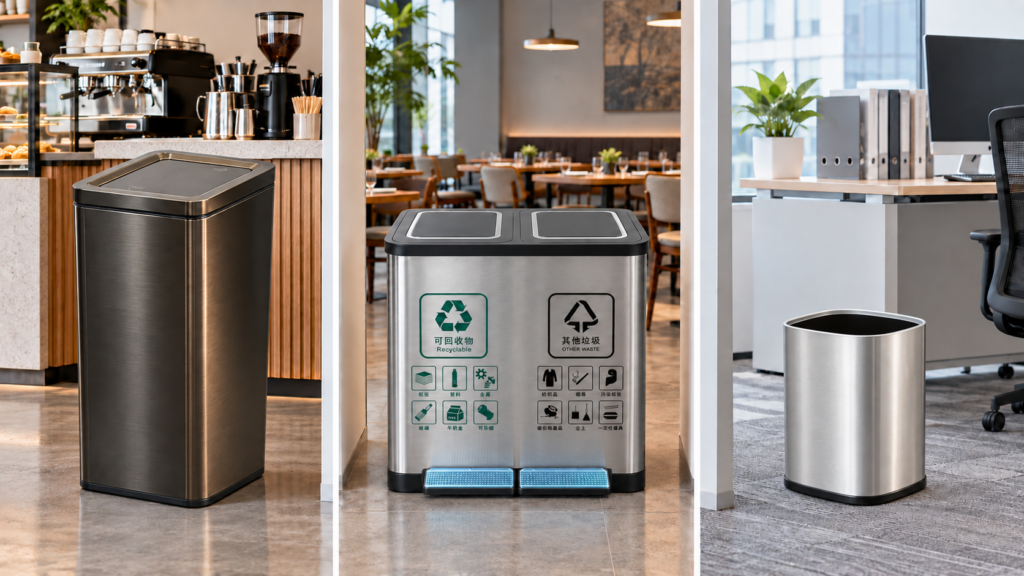
1. Start With the Application, Not the Product
Before comparing individual models, divide the project into different waste-collection areas.
A typical café, restaurant, or office may have several different requirements:
| Application Area | Typical Considerations | Bin Types to Consider |
|---|---|---|
| Customer-facing area | Appearance, footprint, easy disposal | Open top, push lid, swing lid |
| Dining area | Frequent use, easy access, cleaning | Open top, push lid |
| Kitchen | Higher waste volume, cleaning | Large-capacity commercial bin |
| Staff area | Practicality, capacity | Open top, push lid, pedal |
| Bathroom | Hygiene, compact footprint | Pedal bin, small covered bin |
| Office workspace | Quiet use, compact size | Open top, office wastebasket |
| Outdoor/public area | Weather exposure, visibility, cigarette waste | Public-area bin, ashtray bin |
The purpose of this first step is simple:
Do not assume that one bin type should be used throughout the entire project.
A restaurant, for example, may need a combination of different capacities and structures rather than one standardized model.
2. Open Top, Push Lid, Swing Lid or Pedal Bin?
The opening mechanism affects user behavior, maintenance, and the appearance of the waste area.
Open Top Bins
Open-top bins provide direct access and are convenient in locations where users need to dispose of waste frequently.
They can work well in:
- Dining areas
- Offices
- Food-service areas
- Self-service spaces
- High-traffic commercial locations
The main procurement consideration is exposure. Since the waste is more visible, buyers should consider whether the bin will be placed in a customer-facing environment and what type of waste it will receive.
Push-Lid Bins
Push-lid designs provide a more controlled opening while remaining relatively simple to use.
They can be considered for:
- Restaurants
- Offices
- Commercial corridors
- Staff areas
- General indoor waste collection
When comparing models, buyers should check the lid mechanism, cleaning access, opening size, and how the lid is secured to the body.
Swing-Lid Bins
Swing-lid designs can provide a defined opening while keeping part of the waste container visually covered.
They may be useful in:
- Commercial public areas
- Restaurants
- Offices
- Hospitality environments
Procurement teams should pay attention to the swing mechanism and whether the lid can be removed or cleaned easily.
Pedal Bins
Pedal bins allow users to open the lid without directly touching it.
They are commonly considered for areas where hands-free operation is useful, such as:
- Bathrooms
- Hotel rooms
- Staff areas
- Certain food-service environments
- Healthcare-adjacent or hygiene-sensitive commercial spaces, subject to project requirements
For bulk purchasing, buyers should check pedal construction, lid movement, inner bucket design, and the stability of the base.
3. Choose Capacity Based on Waste Volume and Collection Frequency
Capacity should not be selected simply because a certain size is commonly sold.
A better approach is to consider:
Expected waste volume + collection frequency + available floor space + handling requirements
For example, a small office may not need a large central bin if waste is collected frequently. On the other hand, a restaurant kitchen can generate significantly more waste and may require a larger commercial container.
A simple reference framework is:
| Capacity Range | Typical Consideration |
|---|---|
| Small | Individual workstations, bathrooms, hotel rooms |
| Medium | Offices, dining areas, staff areas |
| Large | Kitchens, shared commercial areas, high-volume locations |
| Extra large | Central collection points or applications with infrequent collection |
These are starting points rather than fixed rules.
If waste is collected several times per day, a smaller bin may be practical. If collection happens less frequently, additional capacity may be required.
4. Stainless Steel or Plastic?
Material selection should be based on the environment rather than material preference alone.
Stainless Steel
Stainless steel bins are often considered when buyers want:
- A structured metal body
- A more consistent appearance
- Compatibility with hospitality or office interiors
- Different surface-finishing options
- A product suitable for private-label positioning
For stainless steel models, do not stop at the statement “stainless steel.”
The PO should specify the steel grade, thickness where relevant, surface finish, and other important construction details.
For more information, see the related guide:
Suggested internal link: 410 vs 304 Stainless Steel Waste Bins: How Wholesale Buyers Pick the Correct Grade
Plastic
Plastic bins can be useful when:
- Weight needs to be kept low
- The application is utility-focused
- The environment requires a different material
- Outdoor or back-of-house use is being considered
For plastic commercial bins, buyers should consider wall construction, lid structure, handles or wheels where applicable, cleaning requirements, and packaging efficiency.
5. Don’t Ignore the Inner Bucket
For pedal bins and other covered indoor bins, the inner bucket can have a major impact on daily maintenance.
A removable inner bucket can make it easier to:
- Remove waste bags
- Clean the inside
- Replace liners
- Inspect the bin
- Maintain the product during regular operation
When comparing suppliers, confirm whether the inner bucket is included and whether its material is specified.
For example, a PO can state:
Removable PP inner bucket included.
This is clearer than simply writing:
Stainless steel pedal bin.
6. Check the Base and Floor Contact
The bottom of a commercial waste bin is easy to overlook during product selection.
However, the base affects:
- Stability
- Floor contact
- Cleaning
- Moisture exposure
- Appearance after long-term use
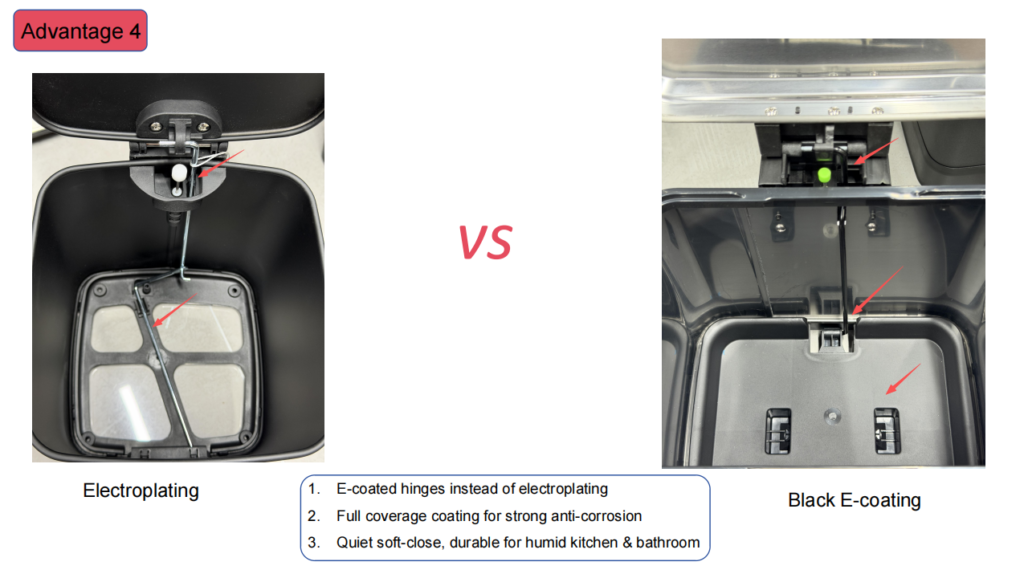
For indoor commercial projects, buyers should check whether the base is fully sealed or whether there are openings that may allow dirt or liquid to enter.
The right specification depends on the application.
For example, a bathroom or food-service environment may have different cleaning requirements from a dry office workstation.
7. Consider Cleaning Before Appearance
A commercial bin can look attractive when new, but procurement teams also need to consider what happens after months of daily use.
Ask:
- Can the inner area be accessed easily?
- Can the lid be removed if needed?
- Is the inner bucket removable?
- Are there difficult-to-clean gaps?
- Can the exterior be wiped easily?
- Does the surface show fingerprints easily?
- Is the finish appropriate for the cleaning method used at the site?
For stainless steel products, surface treatment can also affect the purchasing decision.
Brushed finishes, powder coating, and fingerprint-resistant treatments may serve different design and maintenance requirements.
8. Think About the User’s Movement
Placement matters almost as much as the bin itself.
For a café or restaurant, ask:
- Can customers reach the opening without blocking other people?
- Does the lid interfere with nearby furniture?
- Can staff remove the waste bag easily?
- Does the bin occupy a high-traffic route?
- Is the footprint suitable for the available space?
For offices:
- Does the bin fit underneath or beside the workstation?
- Is it large enough for the actual waste volume?
- Will it interfere with cleaning equipment?
- Is it easy for cleaning staff to move?
For hotel bathrooms:
- Can it be positioned without obstructing the bathroom?
- Is the capacity appropriate for guest use?
- Is the lid mechanism suitable for the environment?
These questions can prevent a common procurement problem: selecting a technically suitable product that does not work well in the actual space.
9. For Multi-Site Projects, Build a Bin Specification Matrix
If a buyer is sourcing bins for multiple cafés, restaurant branches, offices, or hotel rooms, it is useful to create a simple specification matrix.
For example:
| Location | Bin Type | Capacity | Material | Opening | Finish | Packaging |
|---|---|---|---|---|---|---|
| Café dining area | Open top | Medium | Stainless steel | Open | Brushed | Bulk |
| Restaurant kitchen | Commercial | Large | Stainless steel/plastic | Push | Utility | Bulk |
| Office | Wastebasket | Small/medium | Stainless steel | Open | Brushed | Retail/Bulk |
| Bathroom | Pedal | Small | Stainless steel | Pedal | Powder coated | Retail/Bulk |
| Outdoor area | Public bin | Large | According to project | Open/covered | Outdoor finish | Bulk |
This approach helps purchasing teams compare supplier quotations on the same basis.
10. What Should Be Included in Your Supplier Quote?
A commercial bin quotation should ideally make the important specifications visible.
At minimum, ask the supplier to confirm:
- Product model
- Capacity
- Material
- Steel grade if applicable
- Thickness where relevant
- Dimensions
- Lid type
- Inner bucket
- Surface finish
- Color
- Logo method
- Packaging
- Carton quantity
- MOQ
- Sample availability
- Lead time
- Spare parts or replacement policy where applicable
The exact list depends on the project.
For a private-label order, logo, color, packaging, and inspection requirements may be particularly important.
For a standard wholesale order, capacity, material, construction, carton packing, MOQ, and lead time may receive more attention.
11. A Practical Commercial Trash Bin Buying Checklist
Before placing an order, buyers can use this checklist:
Application
- Where will the bin be used?
- Who will use it?
- What type of waste will it receive?
- How frequently will it be emptied?
Product Structure
- Open top, push lid, swing lid, or pedal?
- Appropriate capacity?
- Suitable footprint?
- Removable inner bucket if required?
- Appropriate base construction?
Material
- Stainless steel or plastic?
- Stainless steel grade specified?
- Thickness specified where relevant?
- Surface finish confirmed?
OEM / Private Label
- Logo method confirmed?
- Logo position confirmed?
- Color confirmed?
- Retail packaging required?
- E-commerce/FBA packaging required?
Order
- MOQ confirmed?
- Sample approved?
- Production lead time confirmed?
- Carton packing confirmed?
- Inspection requirements confirmed?
12. Where Different Commercial Bin Types Fit
There is no single structure that covers every commercial application.
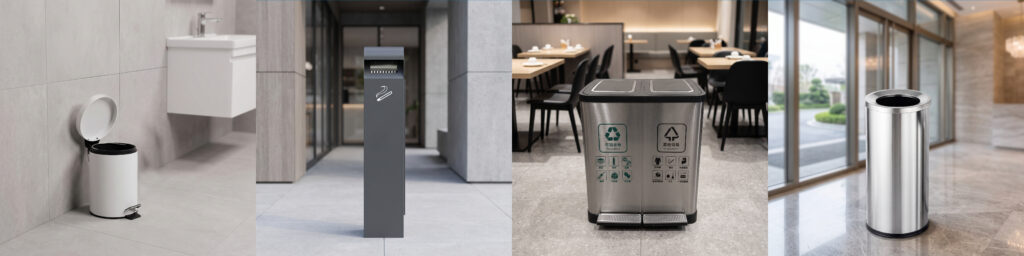
A practical product range may include:
Pedal bins
For bathrooms, hotel rooms, offices, and applications where hands-free opening is useful.
Open-top bins
For areas where frequent disposal and quick access are important.
Push-lid or swing-lid bins
For general commercial waste collection where a more controlled opening is preferred.
Public-area bins
For corridors, entrances, shared spaces, and other common areas.
Ashtray bins
For designated outdoor smoking areas where cigarette waste needs to be collected separately.
The value of a supplier with multiple structures is not simply having more SKUs. It can make it easier for a buyer to build a consistent waste-management product range across different areas of a project.
13. Final Takeaway
Choosing a commercial trash bin should start with the application, not the product catalog.
For cafés, restaurants, and offices, the most useful purchasing questions are:
- Where will the bin be placed?
- What type and volume of waste will it receive?
- How often will it be emptied?
- Which opening mechanism fits the users?
- What capacity and footprint are practical?
- What material and surface finish fit the environment?
- How easy is the bin to clean and maintain?
- What specifications need to be written into the PO?
- Does the packaging match the transportation and sales channel?
A good procurement decision is not necessarily about choosing the largest, most expensive, or most feature-rich bin. It is about matching the product specification with the actual operating environment.
For buyers sourcing commercial waste bins in bulk, private-label products, or mixed product ranges, a clear specification sheet can also make supplier comparison much easier.
Need Help Building a Commercial Bin Range?
If you are sourcing commercial bins for cafés, restaurants, offices, hotels, or distribution, you can send us your target applications, capacities, material requirements, and packaging needs.
Email: info@owinhw.com | sales02@owinhw.com
WhatsApp / WeChat: 0085261915769