
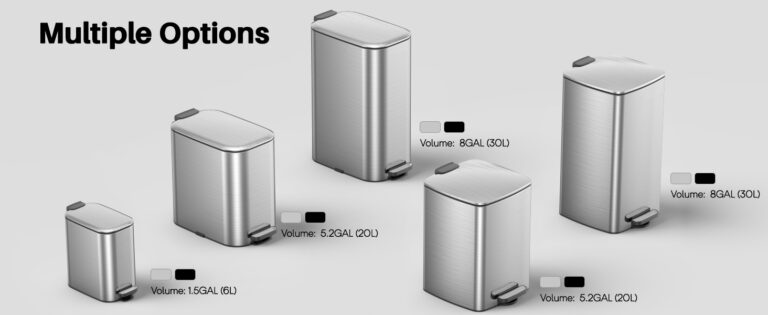
Confused between 410 and 304 stainless‑steel waste bins for bulk sourcing? Compare performance, cost, applicable scenarios and MOQ requirements to make data‑driven procurement decisions for your projects.
Introduction
When sourcing stainless‑steel waste bins for household retail, hotel projects, serviced apartments and small‑scale commercial spaces, wholesale buyers frequently face a core material choice: 410 or 304 stainless steel. There is no universal “better” grade; suitability depends largely on operating environment, expected service life, project budget and after‑risk tolerance.
Many procurement teams only compare unit price on paper, ignoring differences in corrosion‑resistance, surface treatment requirements and minimum‑order constraints, which may lead to unexpected rust‑related complaints or over‑investment in over‑specified materials. This article compares key practical properties of 410 and 304, sorts out suitable application boundaries, and shares real‑world sourcing notes from manufacturer perspective to help buyers make rational trade‑offs.
Core Performance Comparison: 410 VS 304 Stainless Steel For Waste Bin Application
| Evaluation Item | 410 Stainless Steel | 304 Stainless Steel |
|---|---|---|
| Corrosion resistance | Moderate. Performs reliably under normal indoor dry‑to‑moderate‑humidity conditions. Vulnerable to spot rust under persistent salt‑fog, coastal chlorine‑rich environment or long‑term direct water immersion. | Excellent. Strong resistance to humidity, salt‑fog and mild corrosive conditions, widely adopted for high‑humidity coastal scenarios. |
| Mechanical property | Higher hardness, good dent‑resistance; suitable for frequent pedal impact and daily scratch exposure. | Good toughness, relatively lower surface hardness compared with 410. |
| Raw‑material price influence | No nickel‑containing composition, relatively stable raw‑material cost, favourable unit‑price under equal thickness & processing standard. | Contains nickel element; raw‑material cost fluctuates with nickel market price, overall unit cost is higher. |
| Surface finishing option | Brushed anti‑fingerprint, matte powder‑coated / galvanized powder‑coated treatment available to further improve surface anti‑rust performance. | Brushed, matte, mirror polish and multiple coating options are supported. |
| Manufacturer MOQ note at OWIN | Mainstream stock material for most pedal bin series (T1050, T1027,T1038 and more). Flexible MOQ for mixed‑size bulk orders. | Custom‑production grade at OWIN; higher minimum‑order quantity is required, not kept as standard stock material. |
Suitable Scenarios For 410 Stainless‑Steel Waste Bins (OWIN Mainstream Product Line)
410 with proper thickness and qualified surface treatment delivers outstanding cost‑performance under matching operating conditions. It represents our core material solution for most mass‑production pedal‑bin models.
Recommended deployment scenarios:
- inland city chain‑hotel guest rooms, serviced‑apartment units (normal bathroom humidity, non‑coastal area)
- mainstream household kitchen & bathroom retail stock for European, UK and Australian markets
- offices, co‑working spaces, cafes and small restaurants located in non‑coastal regions
- large‑volume renovation projects with controlled budget, focusing on balanced quality and unit‑price
Key reminder for buyers: Even with qualified galvanized powder‑coated or anti‑fingerprint finishing, 410 bins are not ideally suited for persistent salt‑spray coastal resort environments. In such cases, 304 grade is worth considering despite higher overall cost.
When buyers select OWIN 410 series products, consistent thickness standard and standardized surface treatment form the foundation to control real‑world anti‑rust effect. Under equal processing and thickness specification, our 410 series can provide competitive pricing compared with peer suppliers.
When Should Wholesale Buyers Consider 304 Stainless‑Steel Waste Bins
304 brings premium anti‑corrosion capability, yet it comes with higher material cost and higher custom‑order threshold at our factory.
Recommended deployment scenarios:
- coastal seaside resorts, beach‑front serviced apartments with heavy salt‑fog atmosphere
- outdoor semi‑open public areas with frequent moisture and salt exposure
- high‑end hospitality projects with strict long‑term anti‑rust requirement and relatively sufficient procurement budget
Important sourcing note: At OWIN, 304 bins are non‑standard stock items. Custom manufacturing requires higher minimum‑order quantity. Buyers shall confirm MOQ, lead‑time and final unit price before project budgeting. It is not suggested to select 304 if project environment does not demand its superior anti‑corrosion performance, as it may bring unnecessary cost burden.
Practical Procurement Checklist You May Add Into Your PO Documents
- Clarify material grade (410 or 304) in written form, together with actual sheet‑metal thickness requirement, avoid ambiguous descriptions such as “stainless steel only”.
- For 410 selection: specify required surface finish: brushed anti‑fingerprint oil / galvanized powder‑coated. Surface treatment strongly impacts real‑world anti‑rust outcome.
- For 304 custom project: confirm factory‑stated MOQ, production lead‑time and material test‑report supply scope ahead of formal order placement.
- Request material test documents for batch shipment to verify material compliance.
FAQ
Q1: Does 410 stainless steel mean low‑quality? A1: Not inherently. Its performance is environment‑dependent. When deployed in suitable indoor non‑coastal scenarios with qualified thickness and surface finishing, 410 can deliver stable long‑term performance with obvious cost‑performance advantages. It is widely adopted for mass‑produced household and hospitality waste‑bin products across global markets.
Q2: Can I mix 410 and 304 bins within one hotel project? A2: Yes. A common practical solution: adopt cost‑effective 410 for inland standard guest rooms; specify custom 304 only for seaside / pool‑adjacent zones which face heavy salt‑fog exposure. This balances overall project budget and anti‑corrosion demands.
Q3: If my project is coastal but budget is tight, are there alternative work‑arounds? A3: There is no material shortcut for salt‑fog heavy environment. Even upgraded surface treatment on 410 cannot fully offset chloride‑induced corrosion risk. Under tight‑budget coastal‑project conditions, buyers may evaluate reducing service‑life expectation or adjust project budget to adopt 304 specification.
Get Your Custom Material‑Based Sourcing Evaluation & Quotation
If you are evaluating material options for hotel renovation, serviced‑apartment furnishing or retail stock‑building projects, request our material comparison datasheet, bulk quotation and pre‑production samples. You can verify material performance and surface finishing before committing to large‑volume orders.
Contact Email: info@owinhw.com | sales02@owinhw.com
WhatsApp / WeChat : 0085261915769
Learn more about OWIN HOUSEWARE: